Baguettes
November 30, 2022
“I made baguette the other day, the weren't bad but I think my oven just can't get hot enough to do them justice.”
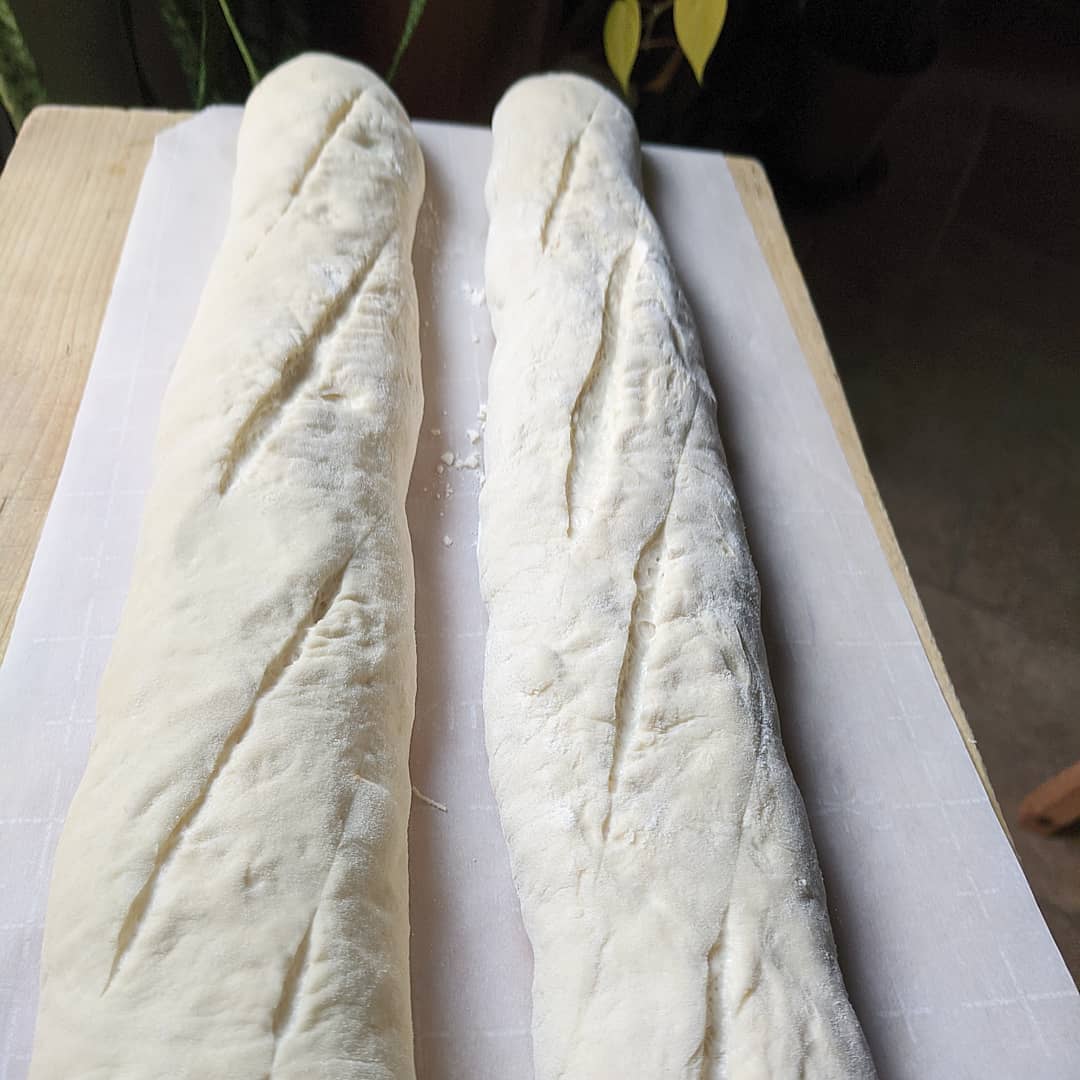
Two shaped baguettes resting on a floured couche, scored and ready for the oven. They weren't bad, but I think my oven just can't get hot enough to do them justice.
And that really is the obstacle. A baguette is the simplest dough there is (flour, water, salt and yeast) and one of the hardest breads to bake at home, because it depends on a very hot, steam-filled deck oven. Steam keeps the surface soft for the first minutes so the loaf can expand and the scores can open into ears, then the dry heat sets a thin, crackling crust. Home bakers get close with a preheated baking stone or steel and a tray of boiling water.
This article is written in Corey’s voice for this tribute site, based on his captions and blog. His own words are the quotes above.
Classic Baguettes
The baguette is the long, crisp loaf of Paris, made from nothing but flour, water, salt and yeast. The shape became standard in the 1920s, and since a 1993 French decree a baguette de tradition may contain only those four ingredients and must be made on the premises. The poolish used here is a wet preferment that Viennese and Polish bakers introduced to Paris in the 19th century.
Ingredients
Poolish
- 150 g unbleached all-purpose or French T65 flour (1 1/4 cups)
- 150 g water at 70°F / 21°C (2/3 cup)
- A pinch of instant yeast, about 0.2 g (1/16 tsp)
Final dough
- 350 g unbleached all-purpose or T65 flour, 11 to 11.7% protein (2 3/4 cups plus 1 tbsp)
- 200 g water at 75°F / 24°C (3/4 cup plus 1 1/2 tbsp)
- 10 g fine sea salt (1 3/4 tsp)
- 2 g instant yeast (generous 1/2 tsp)
- All of the poolish
Method
- Stir the poolish ingredients together until smooth. Cover and leave at cool room temperature for 12 to 14 hours. It is ready when the surface is covered in bubbles and has just begun to dip in the centre.
- Add the final dough water to the poolish to loosen it, then mix in the flour until no dry spots remain. Rest covered for 20 to 30 minutes, then add the salt and yeast and mix by hand or on low speed for 3 to 4 minutes. The dough should be soft and only moderately developed.
- Ferment at about 76°F (24°C) for 1 1/2 to 2 hours, giving the dough one stretch and fold every 30 to 40 minutes, two or three folds in all. It should end up airy, smooth and nearly doubled.
- Divide into 3 pieces of about 285 g. Pre-shape each gently into a short cylinder, cover, and rest for 20 to 30 minutes.
- Pat a piece into a rectangle. Fold the top edge to the centre and press, fold again and seal the seam with the heel of your hand, then roll from the centre outward to 38 cm (15 in), tapering the ends.
- Place seam side up between the folds of a well-floured linen couche or kitchen towel. Cover and proof for 45 to 60 minutes, until a floured finger leaves a dent that springs back slowly.
- Heat a baking stone or steel at 475°F (245°C) for 45 minutes with a cast-iron pan on the rack below. Transfer the loaves seam side down to parchment on a peel and score each with 3 to 5 overlapping cuts down the centre line, holding the blade at a shallow angle.
- Slide onto the stone, pour a cup of boiling water into the hot pan, and close the door. Bake 12 minutes, remove the steam pan, and bake 10 to 14 minutes more, until deep golden brown.
- Cool on a rack for 20 minutes. Baguettes are at their best within 6 hours.
Chef’s notes
- Cuts that do not open into ears usually mean the blade was held upright or the cuts ran across the loaf. Keep the blade nearly flat and let each cut overlap the last by a third.
- A pale, soft crust means not enough heat or steam. Preheat fully and add the water the moment the bread is loaded.
- A tight crumb comes from heavy-handed shaping. Degas only lightly, and never use a rolling pin.
- Too much kneading bleaches the crumb and flattens the flavour. A short mix with folds keeps the crumb creamy and open.
Poolish or long cold fermentation?
Poolish
Jeffrey Hamelman, Raymond Calvel, Ken Forkish
About a third of the flour ferments overnight as a wet sponge, then the dough is mixed and baked the same day. It gives a nutty, sweet aroma and an extensible dough that is easy to shape, and it is the method used here.
Straight dough with a long cold ferment
Philippe Gosselin's pain à l'ancienne as described by Peter Reinhart; Anis Bouabsa in Paris
The whole dough is mixed with very little yeast and held in the refrigerator for 12 to 24 hours or more. Enzymes release more sugar from the flour, giving a sweeter crumb and a darker crust with no separate preferment to manage.
Drawn from the methods of
- Jeffrey Hamelman, Bread (2004)
- Peter Reinhart, The Bread Baker's Apprentice (2001)
- Ken Forkish, Flour Water Salt Yeast (2012)
- Raymond Calvel, The Taste of Bread (2001)
Corey has not published his own formula for this piece. This reference recipe is compiled from the published methods of the chefs and bakers listed above, written in our own words.