Mess with the Bull: The Glazed Chocolate Cake
March 21, 2023
“Mess with the bull you get the horns!”
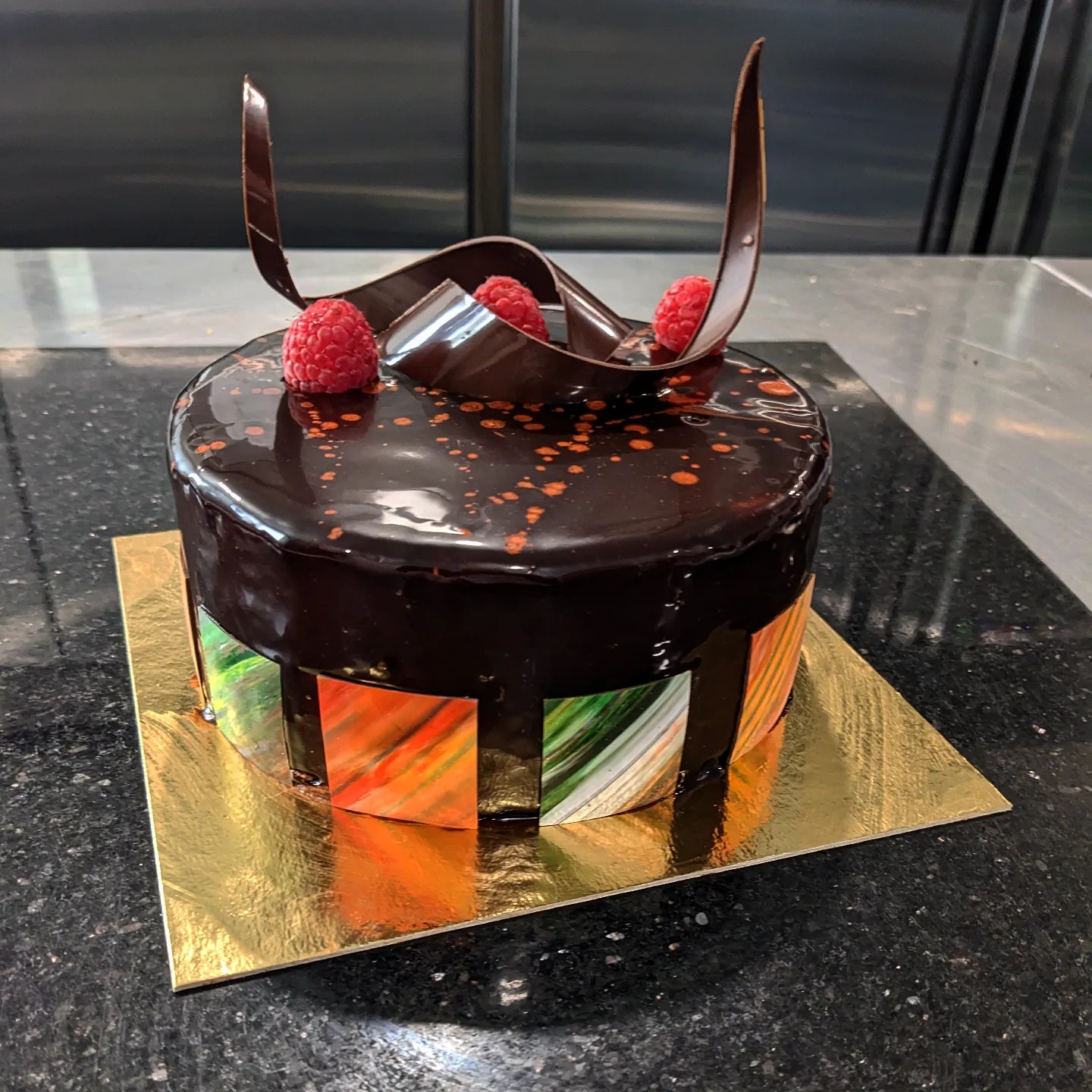
Mess with the bull, you get the horns! This is a dark chocolate cake under a mirror-bright glaze, spattered with orange, banded at the base with colored chocolate panels, and topped with raspberries and two sweeping curved chocolate horns.
The horns are tempered chocolate, spread thin on acetate, cut into long tapering strips and curled while still flexible, then left to set. Only tempered chocolate will hold a curve like that at room temperature and snap cleanly. The patterned panels around the base are made with transfer sheets or colored cocoa butter. Under all the decoration is a classic chocolate glaze, poured in one go over a chilled cake so it levels itself.
This article is written in Corey’s voice for this tribute site, based on his captions and blog. His own words are the quotes above.
Dark Chocolate Mousse Cake with Glaçage and Chocolate Décor
This is the classic French chocolate entremet: a thin chocolate sponge, a deep layer of dark chocolate mousse, and a coat of black cocoa glaçage miroir. Tempered chocolate curls and shards finish it the way pastry shops in Paris have for decades. The mousse here is built on a crème anglaise base, the method taught in most professional chocolate schools.
Ingredients
Chocolate sponge base
- 2 large eggs (100 g)
- 60 g granulated sugar (1/3 cup)
- 40 g all-purpose flour (1/3 cup)
- 15 g Dutch-process cocoa powder (2 1/2 Tbsp)
- 15 g unsalted butter, melted (1 Tbsp)
Dark chocolate mousse
- 150 g whole milk (2/3 cup)
- 150 g heavy cream (2/3 cup)
- 60 g egg yolks (3 large)
- 30 g granulated sugar (2 1/2 Tbsp)
- 300 g dark chocolate, 62 to 66% cacao, chopped
- 400 g heavy cream, cold, for whipping (1 2/3 cups)
Dark cocoa glaçage
- 150 g water (2/3 cup)
- 200 g granulated sugar (1 cup)
- 130 g heavy cream (1/2 cup plus 1 Tbsp)
- 70 g Dutch-process cocoa powder (3/4 cup), sifted
- 10 g powdered gelatin, 200 bloom (1 Tbsp), soaked in 50 g cold water
Tempered chocolate decorations
- 300 g dark couverture chocolate, 60 to 70% cacao, finely chopped
Method
- Heat the oven to 350°F (175°C). Whip the eggs and sugar over a pan of simmering water until warm, about 40°C (104°F), then whip off the heat until tripled and thick. Fold in the sifted flour and cocoa, then the melted butter, and bake in a parchment-lined 8-inch (20 cm) pan for 12-15 minutes. Cool and trim to a 7-inch (18 cm) disc.
- Line an 8-inch (20 cm) ring, 2 inches (5 cm) tall, with an acetate strip and set it on a flat tray lined with film. Place the sponge disc in the center.
- For the mousse, bring the milk and 150 g cream to a simmer. Whisk the yolks with the sugar, temper in the hot liquid, and cook, stirring constantly, to 82-84°C (180-183°F), until the custard coats a spatula.
- Strain the hot custard over the chocolate, wait one minute, then stir from the center until glossy and smooth. Cool to 40-45°C (104-113°F).
- Whip the 400 g cream to soft peaks. Fold a third into the chocolate base, then the remainder, and pour into the ring over the sponge. Level the top exactly flush with a long spatula and freeze overnight.
- For the glaçage, whisk the water, sugar, cream and cocoa in a deep saucepan and boil, stirring, to 103°C (217°F). Off the heat, stir in the soaked gelatin, strain, press film onto the surface and cool. Use it at 32-35°C (90-95°F).
- Temper the couverture by seeding: melt two thirds to 45-50°C (113-122°F), stir in the remaining third off the heat until the mass falls to 27-28°C (81-82°F), then warm gently to a working temperature of 31-32°C (88-90°F). Spread thinly on acetate for shards, or on a marble slab to scrape into curls, and let set at cool room temperature.
- Unmold the frozen cake onto a rack over a tray and peel off the acetate. Pour the glaçage in one pass, starting at the edge and finishing in the center, and smooth once with an offset spatula if needed.
- Transfer to a board, thaw in the refrigerator for at least 4 hours, and arrange the chocolate decorations just before serving so they stay crisp.
Chef’s notes
- Grainy mousse means the chocolate base was too cold when the cream went in and the cocoa butter set in specks. Fold at 40-45°C (104-113°F) for dark chocolate and work quickly.
- A dull or streaky decoration is out of temper. Test a smear on parchment: properly tempered chocolate sets glossy within 5 minutes at 18-20°C (65-68°F).
- Cook the glaçage fully to 103°C (217°F). Undercooked glaze stays thin and runs off the sides, leaving bare patches at the top edge.
- For clean slices, dip a long knife in hot water, wipe dry, and cut straight down. Rewarm and wipe between every cut.
Temper by seeding or on the marble?
Seeding
Thomas Keller and Sebastien Rouxel, Peter Greweling, most modern pastry kitchens
Unmelted, already tempered chocolate is stirred into melted chocolate to cool it and supply stable cocoa butter crystals. It is clean, needs no special surface and is easy to repeat, which is why this recipe uses it.
Tabling
Classical French chocolatiers and the method taught at Ferrandi Paris
Two thirds of the melted chocolate is poured onto cool marble and worked with a scraper until it thickens, then returned to the bowl to bring the whole mass to working temperature. It is faster for large batches and teaches you to read the chocolate by feel, but it takes practice and a cool room.
Drawn from the methods of
- Frédéric Bau and École du Grand Chocolat Valrhona, Cooking with Chocolate (2011)
- Pierre Hermé and Dorie Greenspan, Chocolate Desserts by Pierre Hermé (2001)
- Peter Greweling, Chocolates and Confections (2007)
- Ferrandi Paris, French Pâtisserie (2017)
Corey has not published his own formula for this piece. This reference recipe is compiled from the published methods of the chefs and bakers listed above, written in our own words.