The First Saint-Honoré
May 2, 2023
“First time making a saint honoré...well I did like 85% of it, but that still counts!”
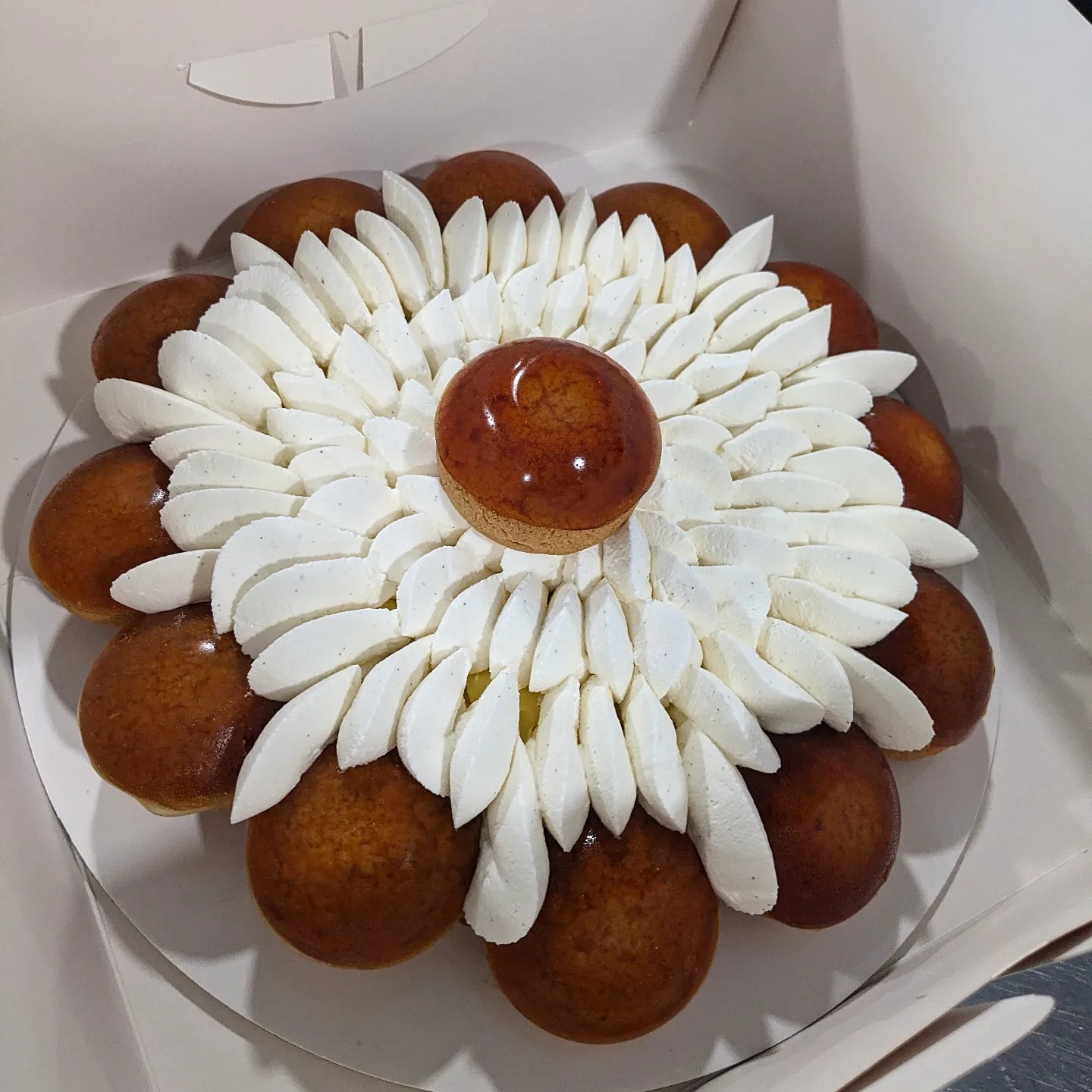
My first time making a Saint-Honoré! Well, I did like 85% of it, but that still counts. A ring of caramel-dipped choux puffs surrounds a dome of cream piped in long white petals, with one last glazed puff set in the center.
The gâteau Saint-Honoré is named for the patron saint of bakers and pastry cooks, and it is a deliberate test of the craft: a pastry base, choux pastry, cooked caramel, and a piped cream, traditionally the light crème chiboust, all in one cake. The petal effect comes from a special notched Saint-Honoré piping tip. The caramel on the puffs is cooked to a clear amber, and each puff gets dipped by hand while the sugar is still dangerously hot.
This article is written in Corey’s voice for this tribute site, based on his captions and blog. His own words are the quotes above.
Gâteau Saint-Honoré
The Saint-Honoré is a showpiece of French pâtisserie: a pastry base ringed with choux, crowned with caramel-dipped cream puffs, and filled with piped cream. It was created in the 1840s at the Chiboust pastry shop on the rue Saint-Honoré in Paris, and shares its name with Saint Honoré, the patron saint of bakers and pastry cooks.
Ingredients
Base
- 250 g all-butter puff pastry, classic or rough puff (9 oz)
Choux paste
- 60 g water (1/4 cup)
- 60 g whole milk (1/4 cup)
- 55 g unsalted butter, cubed (4 tbsp)
- 2 g granulated sugar (1/2 tsp)
- 2 g fine sea salt (1/3 tsp)
- 70 g all-purpose flour, sifted (1/2 cup plus 1 tbsp)
- 125 g eggs, beaten (about 2 1/2 large)
Vanilla pastry cream
- 350 g whole milk (1 1/2 cups)
- 1 vanilla bean, split and scraped
- 70 g egg yolks (4 large)
- 70 g granulated sugar (1/3 cup)
- 30 g cornstarch (1/4 cup)
- 25 g unsalted butter (2 tbsp)
Caramel
- 200 g granulated sugar (1 cup)
- 60 g water (1/4 cup)
- 40 g glucose or light corn syrup (2 tbsp)
Chantilly cream
- 300 g heavy cream, at least 35% fat, very cold (1 1/4 cups)
- 30 g mascarpone, optional, for stability (2 tbsp)
- 30 g powdered sugar (1/4 cup)
- 1 tsp vanilla paste or extract
Method
- Make the pastry cream: simmer the milk with the vanilla, whisk the yolks, sugar and cornstarch, whisk in the hot milk, return to the pan and boil for 1 full minute while whisking. Whisk in the butter, cover the surface with plastic wrap, and chill until cold.
- Roll the puff pastry 3 mm (1/8 in) thick, cut a 22 cm (9 in) disc, set it on a parchment-lined tray, prick it all over with a fork, and chill for 30 minutes.
- Make the choux paste: boil the water, milk, butter, sugar and salt, stir in the flour off the heat, then dry over medium heat for 2 minutes until a film forms on the pan. Cool slightly in a mixer and beat in the egg gradually, until the paste is glossy and falls from the paddle in a V.
- With a 10 mm (3/8 in) plain tip, pipe a ring of choux around the pastry disc 1 cm in from the edge, then a loose spiral in the centre to support the cream. On a second tray, pipe about 16 small puffs, 3 cm (1 1/4 in) across.
- Bake both trays at 375°F (190°C). The small puffs take 25 to 30 minutes and the base 30 to 35 minutes. Everything should be deep golden brown and dry. Pierce the base of each puff and cool completely.
- Whisk the cold pastry cream smooth. Fill the puffs through the base, and spread the remaining cream over the centre of the base, inside the choux ring.
- For the caramel, cook the sugar, water and glucose without stirring to a clear amber, 330-340°F (165-170°C), then dip the base of the pan in cold water for 5 seconds to stop the cooking. Holding each puff by its base, dip the top into the caramel and set it caramel side down on a silicone mat for a flat, glassy cap.
- When the caps have set, dip the base of each puff in the caramel, rewarming it gently if it thickens, and stick the puffs side by side on the choux ring.
- Whip the cream, mascarpone, powdered sugar and vanilla to firm peaks. Using a Saint-Honoré tip or a large star tip, pipe the Chantilly over the pastry cream in the centre in a zigzag or rosettes, mounding it slightly. Chill and serve within 4 hours.
Chef’s notes
- Caramel burns are serious. Keep a bowl of ice water beside you, never touch the hot sugar, and dip the puffs with care, or with tongs if you prefer.
- Caramel weeps and turns sticky in a humid refrigerator. Assemble the cake on the day and as close to serving as possible.
- If the caramel hardens before you finish, rewarm it over low heat without stirring. If it darkens past deep amber it will taste bitter, so start a new batch.
- Bake the base until truly crisp. An underbaked base softens quickly beneath the cream.
Crème Chiboust or pastry cream and Chantilly?
Crème Chiboust
The original 19th century recipe; Le Cordon Bleu and Ferrandi Paris teach it as the classic filling
Warm pastry cream is set with gelatin and lightened with Italian meringue, giving a cream invented for this very cake. It is airy and traditional, but it must be made and piped at once and does not keep well.
Pastry cream with Chantilly
Most contemporary Paris pastry shops, including Pierre Hermé's flavoured versions
The puffs and base are filled with pastry cream and the top is piped with vanilla whipped cream. It is simpler, more stable and fresher tasting, and it is the method this recipe follows.
Drawn from the methods of
- Ferrandi Paris, French Pâtisserie (2017)
- Le Cordon Bleu
- Bo Friberg, The Professional Pastry Chef
- Pierre Hermé
Corey has not published his own formula for this piece. This reference recipe is compiled from the published methods of the chefs and bakers listed above, written in our own words.