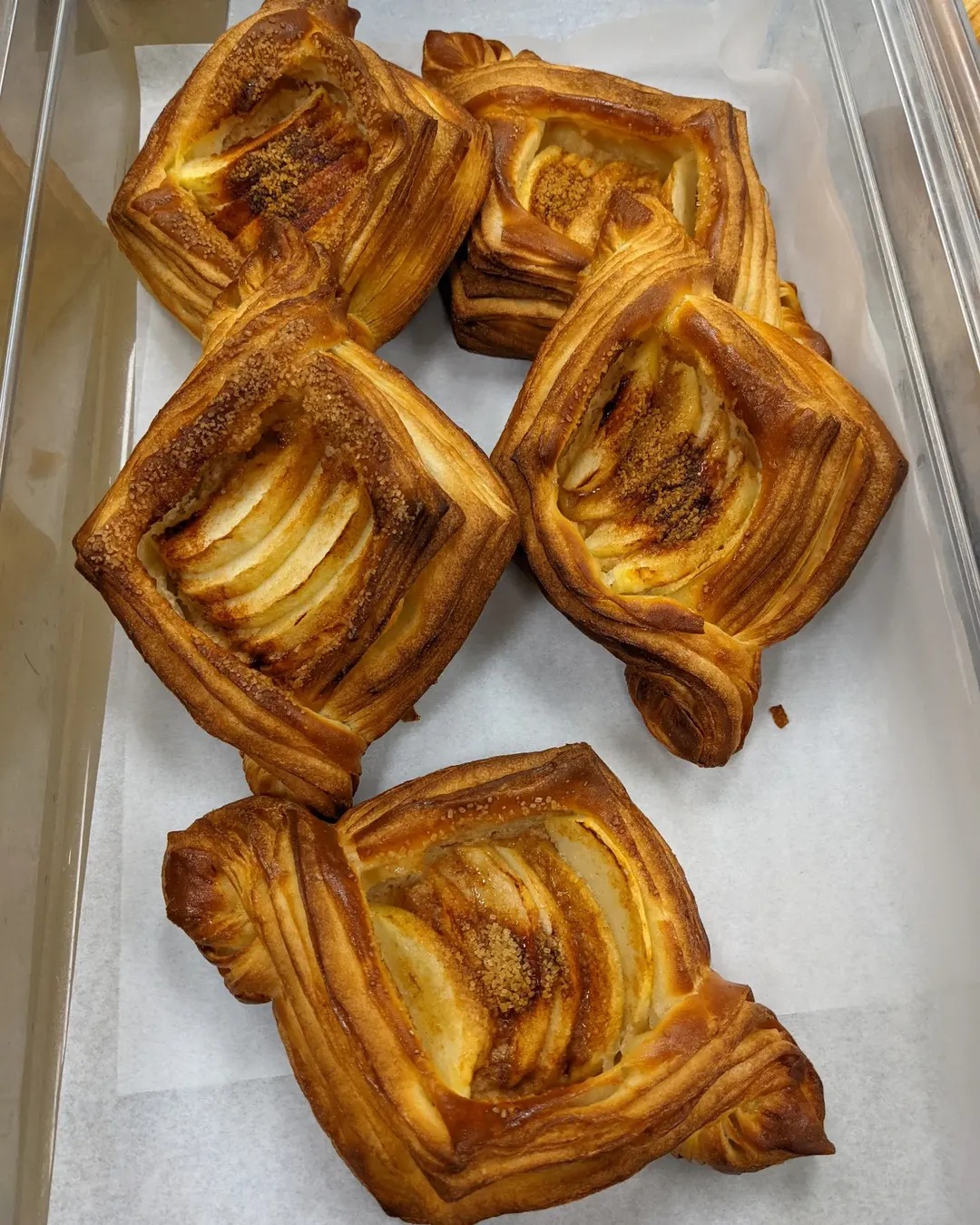
Apple Danish
November 30, 2022
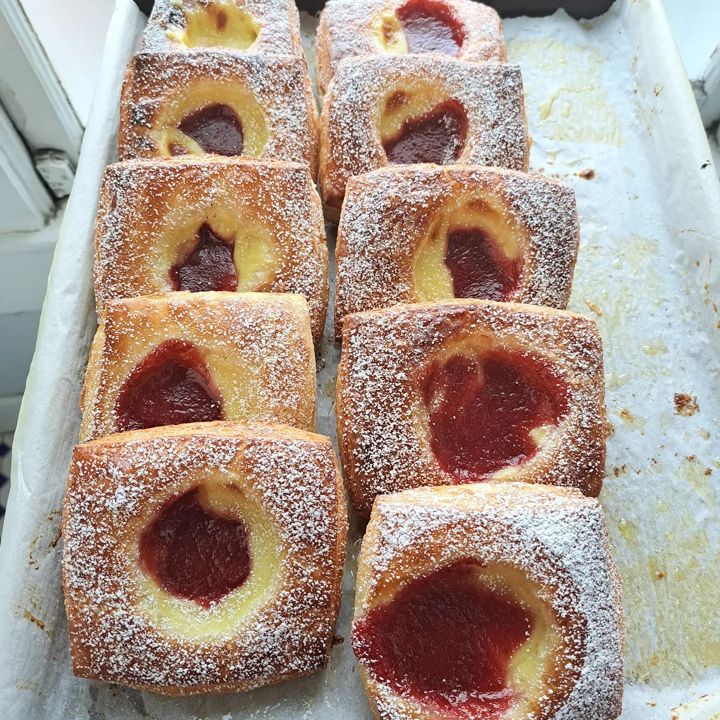
“Apple Danish: a little dark and too much sugar thrown everywhere, but not too bad.”
A little dark and too much sugar thrown everywhere, but not too bad. These are square danishes with thin apple slices shingled in the center and the corners folded in, baked dark and glossy.
I may have been hard on myself with that one. A deep bake is what gives laminated pastry its flavor, and in French bakeries a pale danish is considered underdone. The folded-corner shape is a classic: a square of dough with cuts from each corner toward the center, folded to frame the filling. Apple is the traditional partner because its acidity cuts through the butter, and slicing it thin lets it cook through in the same time as the pastry.
This article is written in Corey’s voice for this tribute site, based on his captions and blog. His own words are the quotes above.
Danish Pastry with Cream Cheese and Fruit
Danish dough is laminated like croissant dough but enriched with egg and more sugar, which makes it softer, richer and more cake-like. In Denmark it is called wienerbrød, Vienna bread, because the technique arrived with Austrian bakers who were hired during a Danish bakery workers' strike around 1850. Danish bakers then made it their own with extra butter and sweet fillings.
Ingredients
Dough
- 500 g bread flour (about 4 cups)
- 60 g granulated sugar (1/4 cup plus 2 tsp)
- 10 g fine sea salt (1 3/4 tsp)
- 10 g instant yeast (1 tbsp)
- 2 g ground cardamom, optional (1 tsp)
- 100 g eggs, cold (2 large)
- 200 g cold whole milk (3/4 cup plus 1 1/2 tbsp)
- 40 g unsalted butter, soft (3 tbsp)
Butter block
- 300 g European-style unsalted butter, cold (2 sticks plus 5 tbsp)
Cream cheese filling
- 225 g full-fat cream cheese, soft (8 oz)
- 50 g granulated sugar (1/4 cup)
- 1 large egg yolk
- 10 g all-purpose flour (1 tbsp)
- 1 tsp vanilla extract
- Finely grated zest of 1/2 lemon
Pastry cream filling (alternative)
- 250 g whole milk (1 cup)
- 3 large egg yolks (55 g)
- 50 g granulated sugar (1/4 cup)
- 22 g cornstarch (2 1/2 tbsp)
- 20 g unsalted butter (1 1/2 tbsp)
- 1 tsp vanilla extract
Fruit and finish
- 250 g fruit: thick jam, cooked apple, or fresh berries (about 1 cup)
- 1 egg beaten with 1 tbsp milk, for egg wash
- 30 g sliced almonds, optional (1/3 cup)
- 80 g apricot jam, warmed and strained, for glazing (1/4 cup)
- 120 g powdered sugar mixed with 20 g milk, for icing (1 cup and 4 tsp)
Method
- Mix the dough ingredients on low speed for 4 to 5 minutes, just until smooth. Danish dough needs less kneading than bread because the folding builds its strength. Press into a 20 cm (8 in) square, wrap, and chill at least 4 hours or overnight.
- Pound the butter between parchment into an 18 cm (7 in) square and chill until firm but pliable. Roll the dough to a 26 cm (10 in) square, set the butter on it as a diamond, and fold the corners over to enclose it.
- Roll to a 20 x 60 cm (8 x 24 in) rectangle and fold in thirds like a letter. Chill 30 minutes. Repeat for a total of three single folds, turning 90 degrees each time and chilling between folds, then rest the dough 1 hour or overnight.
- Make the filling. For cream cheese, beat everything together until smooth. For pastry cream, whisk yolks, sugar and cornstarch, pour over the hot milk, return to the pan and boil for 1 full minute while whisking, then stir in butter and vanilla and chill with plastic pressed on the surface.
- To shape a braid, cut the dough in half and roll one half to a 25 x 35 cm (10 x 14 in) rectangle on parchment. Mentally divide it into three long strips and spread half the filling down the centre third, then top with half the fruit.
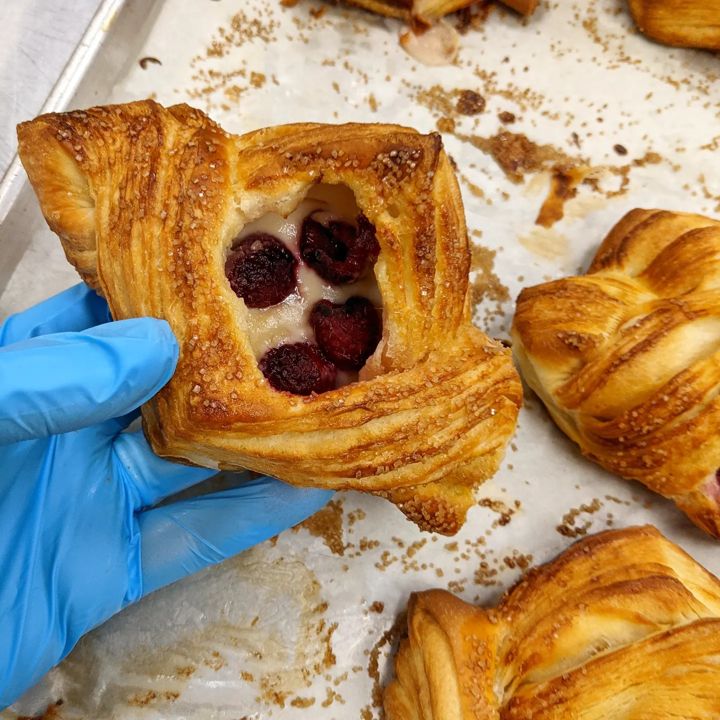
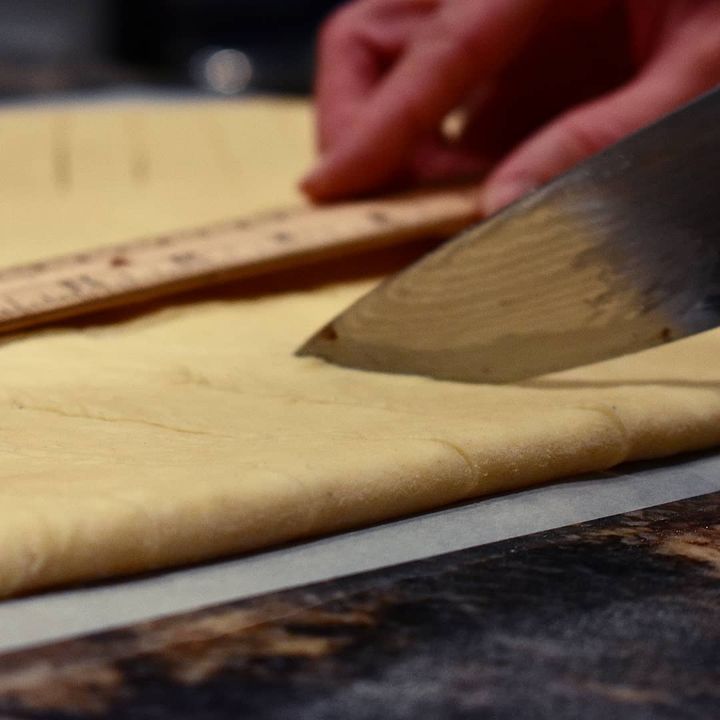
- With a sharp knife, cut the two outer thirds into diagonal strips 2 cm (3/4 in) wide, angled down and away from the filling like a chevron. Fold the top flap down over the filling, then cross the strips over one at a time, alternating left and right, and tuck the last ends underneath. Repeat with the second half.
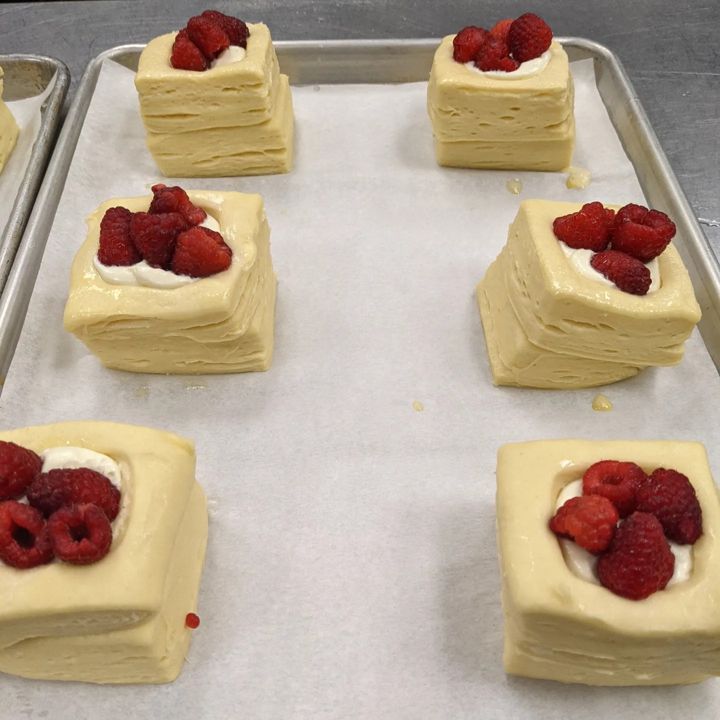
- For individual pastries, roll the dough 5 mm thick, cut 10 cm (4 in) squares, fold the corners in to the centre or leave open, press a well in the middle, and add a spoonful of filling and fruit.
- Brush with egg wash and proof at 75-79°F (24-26°C) for 1 1/2 to 2 hours, until puffy and jiggly. Egg wash again and scatter with almonds if using.
- Bake at 375°F (190°C) until deep golden brown: 25 to 30 minutes for braids, 16 to 20 minutes for individual pastries.
- Brush with warm apricot glaze as soon as they leave the oven. Cool for 20 minutes, then drizzle with the icing.
Chef’s notes
- Wet fruit makes a soggy bottom. Use thick jam or fruit that has been cooked down, and keep fresh berries to a single layer.
- Do not overfill a braid. The filling expands in the oven and will burst through the strips if the centre is heaped.
- If the cream cheese filling runs, the cheese was too warm or the flour was left out. A tablespoon of flour or cornstarch keeps it in place.
- Bake to a dark golden brown. Pale Danish is doughy in the middle, where the filling slows the bake.
Drawn from the methods of
- Bo Friberg, The Professional Pastry Chef
- Jeffrey Hamelman, Bread (2004)
- King Arthur Baking Company
- Ferrandi Paris, French Pâtisserie (2017)
Corey has not published his own formula for this piece. This reference recipe is compiled from the published methods of the chefs and bakers listed above, written in our own words.