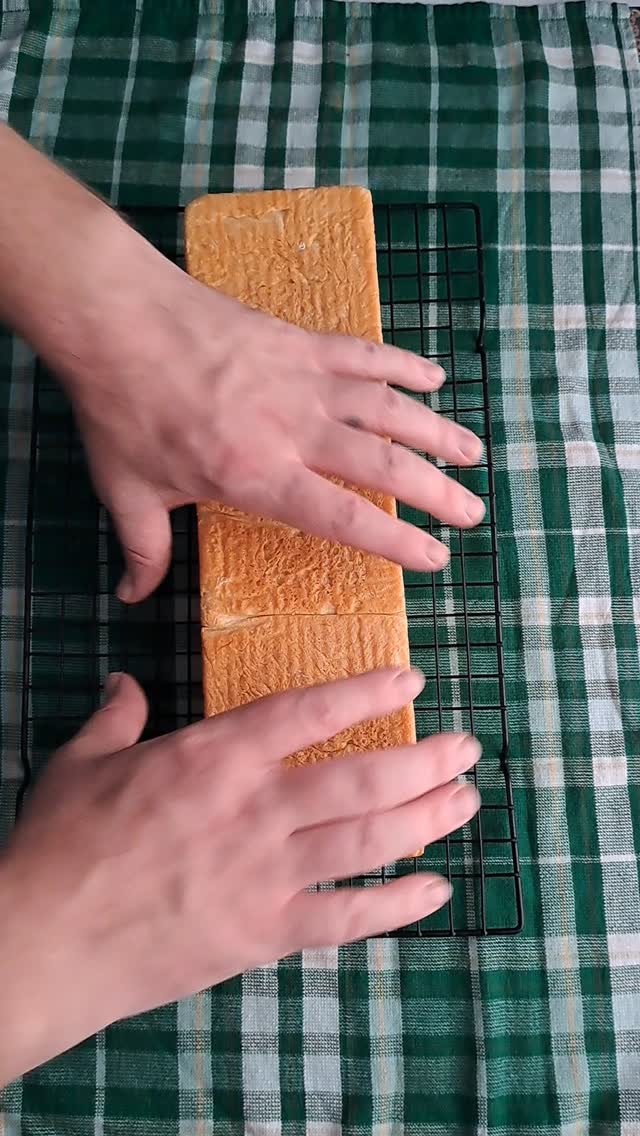
The Pullman Loaf, Second Attempt
February 11, 2026
“2nd attempt at a pullman loaf.”
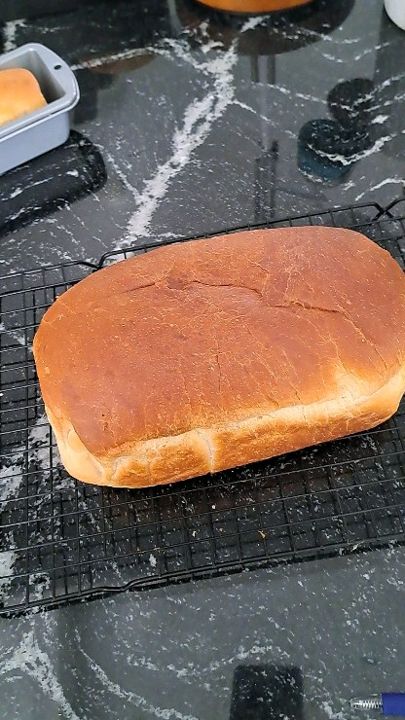
A long, perfectly square loaf with corners sharp enough to measure, and me pressing it gently between two hands to show the spring. The Pullman loaf, or pain de mie, is baked in a straight-sided pan with a sliding lid, so the dough has nowhere to dome. It fills the pan, presses against the lid and comes out as a golden brick with a fine, tight crumb and almost no crust.
The name comes from the Pullman railway cars, where the compact, stackable shape suited a tiny galley kitchen. Getting it right is mostly a matter of dough weight and timing: too little dough or too short a proof and the top corners stay rounded, too much and the dough forces the lid. This was my second attempt, and the corners tell me I filled the pan just right. This post is a video on Instagram.
This article is written in Corey’s voice for this tribute site, based on his captions and blog. His own words are the quotes above.
Pain de Mie (Pullman Loaf)
Pain de mie is the French sandwich loaf, named for its mie, the soft crumb. It is baked in a straight-sided pan with a sliding lid, which gives a square slice with a fine, tight crumb and almost no crust. In America the same pan is called a Pullman pan, after the railway dining cars where the compact, stackable loaves were used.
Ingredients
Dough
- 550 g bread flour or unbleached all-purpose flour (about 4 1/2 cups)
- 250 g whole milk, lukewarm (1 cup)
- 100 g water, lukewarm (scant 1/2 cup)
- 30 g granulated sugar (2 1/2 tbsp)
- 11 g fine sea salt (scant 2 tsp)
- 8 g instant yeast (2 1/2 tsp)
- 55 g unsalted butter, soft (4 tbsp)
For the pan
- Soft butter, for greasing the pan and the inside of the lid
Method
- Combine everything except the butter and mix on low speed for 3 minutes. Add the butter and knead on medium for 8 to 10 minutes, until the dough is very smooth and passes the windowpane test. A fully developed dough is what gives the fine, even crumb.
- Cover and let rise at room temperature for 60 to 90 minutes, until doubled.
- Butter the pan and the underside of the lid thoroughly. Turn the dough out, press it firmly into a rectangle about 30 cm (12 in) wide, and knock out all the large bubbles.
- Roll the dough up tightly from the long side into a log the length of the pan, pinching the seam closed. Place it seam side down in the pan and press it gently into the corners.
- Slide the lid on, leaving a small gap so you can watch. Proof for 45 to 60 minutes, until the dough is 1 to 1.5 cm (about 1/2 in) below the rim. Close the lid fully.
- Bake at 350°F (175°C) for 25 minutes with the lid on. Carefully slide the lid off and bake 15 to 20 minutes more, until golden and 190-195°F (88-90°C) in the centre.
- Turn the loaf out of the pan at once and cool on a rack so the sides do not steam and soften. Cool completely, at least 2 hours, before slicing thinly.
Chef’s notes
- If the lid goes on too late, dough squeezes out and bakes into a ridge, and the crumb is compressed. If it goes on too early, the corners are rounded. Close it when the dough is about 1 cm below the rim.
- Large holes come from loose shaping. Degas firmly and roll the log tight.
- The pan size matters. For a 23 cm (9 in) Pullman pan, make two-thirds of the recipe.
- The loaf slices best the next day and keeps for 4 to 5 days well wrapped.
Drawn from the methods of
- King Arthur Baking Company
- Jeffrey Hamelman, Bread (2004)
- Rose Levy Beranbaum, The Bread Bible (2003)
Corey has not published his own formula for this piece. This reference recipe is compiled from the published methods of the chefs and bakers listed above, written in our own words.