The Yule Log That Didn't Crack
December 29, 2018
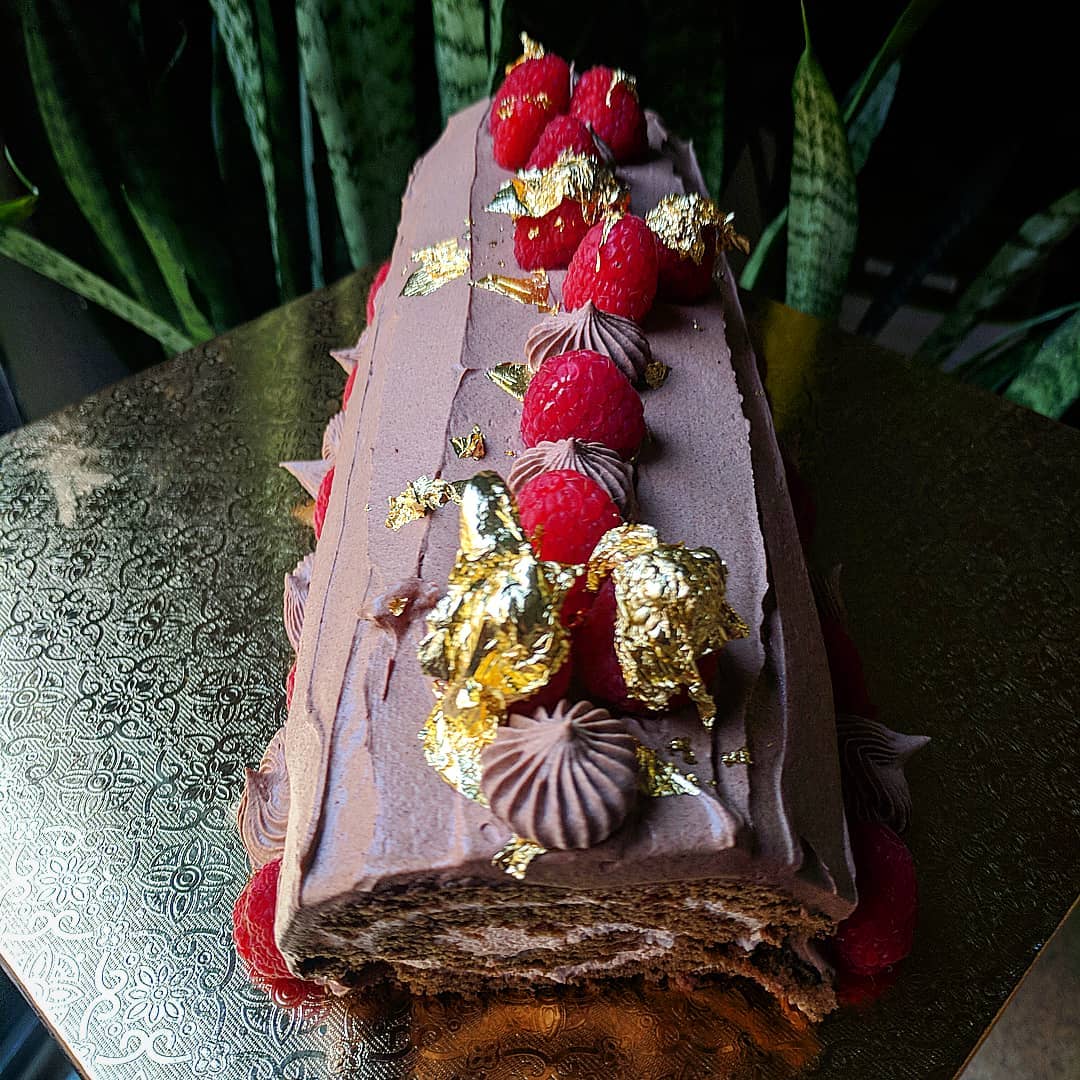
“yulelog I finally have gotten these down so the don't crack horribly when I roll them.”
I have finally gotten these down so they don't crack horribly when I roll them. This is a bûche de Noël covered in lavender-tinted cream, decorated with raspberries, piped rosettes and a generous amount of gold leaf.
This one closes a loop for me. In February 2017 I documented a roll cake on the blog that shattered into pieces, and I mentioned an earlier Bûche de Noël that had done the same. Here, nearly two years on, is the clean roll. The usual fixes are a flexible sponge with enough egg and little or no butter, not overbaking it by even a minute, and rolling it while it's warm so it sets in a curve. The yule log itself is a French Christmas tradition dating to the nineteenth century.
This article is written in Corey’s voice for this tribute site, based on his captions and blog. His own words are the quotes above.
Bûche de Noël (Chocolate Yule Log)
The bûche de Noël is the French Christmas cake, a rolled sponge shaped and frosted to look like the log once burned on the hearth through the holiday. It appeared in Parisian pastry shops in the second half of the nineteenth century, though which pâtissier made it first is not settled. This one uses a flexible chocolate sponge, a mascarpone cream filling and a ganache bark.
Ingredients
Chocolate roulade sponge
- 6 large eggs, separated, at room temperature
- 150 g granulated sugar (3/4 cup), divided
- 60 g cake flour (1/2 cup)
- 40 g Dutch-process cocoa powder (scant 1/2 cup), plus extra for the towel
- 40 g neutral oil or melted butter (3 Tbsp)
- 1 tsp vanilla extract
- 1/4 tsp fine salt
Mascarpone cream filling
- 300 g heavy cream, cold (1 1/4 cups)
- 150 g mascarpone, cold (2/3 cup)
- 40 g powdered sugar (1/3 cup)
- 1 tsp vanilla extract, or 1 tsp instant espresso dissolved in 1 tsp water
Ganache bark
- 300 g dark chocolate, 55 to 62% cacao, chopped
- 300 g heavy cream (1 1/4 cups)
- 30 g honey or light corn syrup (1 1/2 Tbsp)
To finish
- Powdered sugar for snow
- Meringue mushrooms, sugared cranberries or rosemary sprigs (optional)
Method
- Make the ganache first so it has time to set. Bring the cream and honey to a simmer, pour over the chocolate, stir until smooth, and leave at cool room temperature for 2-3 hours until it spreads like soft butter.
- Heat the oven to 375°F (190°C). Line a 13 x 18-inch (33 x 46 cm) half sheet pan with parchment and lightly grease the paper.
- Whip the yolks with 75 g of the sugar until pale and thick, about 4 minutes, then beat in the oil and vanilla. In a clean bowl whip the whites and salt to soft peaks, add the remaining 75 g sugar gradually, and whip to a glossy meringue with peaks that just curl.
- Fold a third of the meringue into the yolks, then sift the flour and cocoa over the top and fold with the remaining meringue until just combined. Spread evenly into the corners of the pan.
- Bake 10-12 minutes, only until the cake springs back when touched. Do not wait for it to pull from the sides: an overbaked sheet will crack.
- Dust a clean kitchen towel with cocoa. Run a knife around the hot cake, turn it out onto the towel, peel off the parchment, and roll it up with the towel from a short side while it is still steaming. Cool seam side down for about 1 hour.
- Whip the cream, mascarpone, powdered sugar and vanilla together to firm peaks. Unroll the cake gently, spread the filling to within 3/4 inch (2 cm) of the far edge, and roll it back up without the towel. Chill 1 hour.
- Cut a 3-inch (8 cm) piece off one end on a sharp diagonal and attach it to the side or top of the log with ganache to make a branch.
- Cover the log with ganache, leaving the cut ends bare to show the spiral, and drag a fork or small palette knife along it for bark. Chill until set, then dust with powdered sugar and decorate.
Chef’s notes
- Cracks come from a dry or overbaked sponge or from rolling a cake that has gone cold and set flat. Pull it at 10-12 minutes and shape it while hot so it remembers the curve.
- If the cake does crack, keep going. Ganache hides everything, and a log is supposed to look rough.
- Ganache that sets too hard to spread can be loosened by stirring over barely warm water for a few seconds. Ganache that is too soft needs more time, not the refrigerator, which makes it set unevenly.
- The filled, unfrosted roll freezes well for up to a month. Thaw in the refrigerator, then frost.
Roll the sponge hot, or cool it flat?
Roll hot in a towel
Rose Levy Beranbaum, King Arthur Baking Company and most American and classical French recipes
The sheet is turned out and rolled in a dusted towel the moment it leaves the oven, then cooled in that shape, so the crumb sets with the curve already in it. It is the safest insurance against cracking for a lean sponge. This recipe follows this method.
Cool flat, then roll once
Stella Parks, and the Japanese roll cake tradition
The cake is cooled flat under a cover that traps its steam, then filled and rolled a single time. Supporters argue that pre-rolling compresses the crumb and tears the surface, and that a moist, well-formulated sponge needs no training at all.
Drawn from the methods of
- Rose Levy Beranbaum, The Cake Bible (1988)
- Dorie Greenspan, Baking Chez Moi (2014)
- Ferrandi Paris, French Pâtisserie (2017)
- King Arthur Baking Company
Corey has not published his own formula for this piece. This reference recipe is compiled from the published methods of the chefs and bakers listed above, written in our own words.