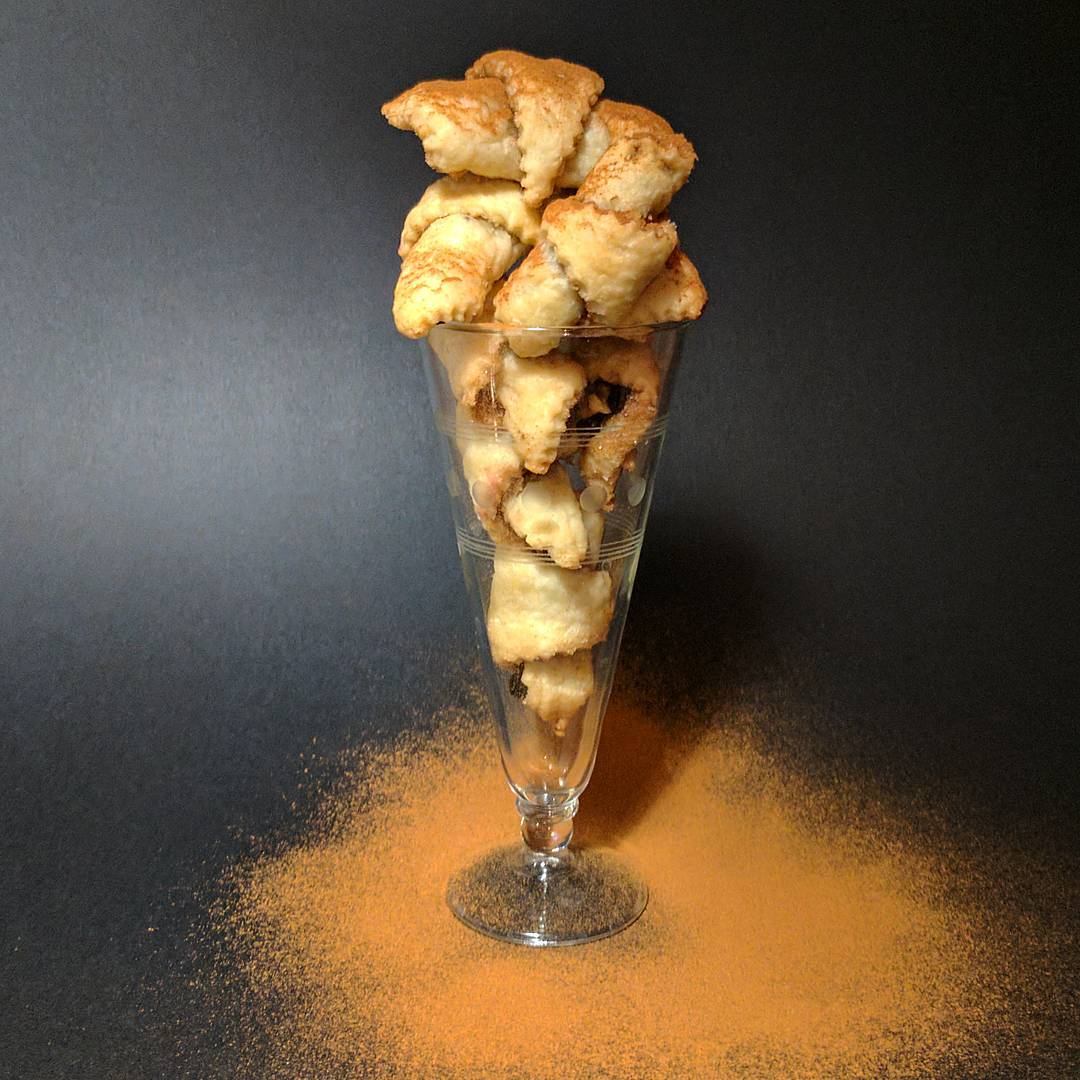
Rugelach
April 9, 2017 to April 10, 2017
“Part One of making”
“Part two of making”
“Rugelach”
This is my glamour shot: a tall parfait glass stacked high with golden rugelach on a black background, dusted with a drift of cinnamon sugar. I also posted two videos from the same day, part one and part two, where I roll out the dough, spread it with filling, cut it with a fluted wheel and roll the pieces up by hand.
Rugelach are small filled pastries from the Jewish communities of Eastern Europe. The name is Yiddish, often translated as little twists. The modern American version uses a dough enriched with cream cheese, which makes it tender, flaky and easy to handle. You roll the dough out, cover it with cinnamon sugar, nuts, raisins or jam, cut it into wedges and roll each one from the wide end into a crescent. This was week one of my cookie course.
This article is written in Corey’s voice for this tribute site, based on his captions and blog. His own words are the quotes above.
Cream Cheese Rugelach
Rugelach are small rolled pastries from the Ashkenazi Jewish kitchens of Central and Eastern Europe, where the dough was traditionally made with yeast or sour cream. The cream cheese dough is an American development of the 20th century, and it is now the version most bakeries in the United States make. The filling here is the classic one: jam, cinnamon sugar, walnuts and currants.
Ingredients
Dough
- 260 g all-purpose flour (2 cups)
- 25 g granulated sugar (2 tablespoons)
- 3 g fine sea salt (1/2 teaspoon)
- 225 g unsalted butter, cold, cut into cubes (1 cup)
- 225 g full-fat block cream cheese, cold, cut into cubes (8 ounces)
Filling
- 160 g apricot or raspberry jam (1/2 cup)
- 100 g granulated sugar (1/2 cup)
- 5 g ground cinnamon (2 teaspoons)
- 120 g walnuts, toasted and finely chopped (1 cup)
- 80 g dried currants or finely chopped raisins (1/2 cup)
Finish
- 1 large egg beaten with 1 teaspoon water
- Coarse or granulated sugar, for sprinkling
Method
- Pulse the flour, sugar and salt in a food processor. Scatter the cold butter and cream cheese over the top and pulse until the dough forms large, moist clumps; stop before it becomes a smooth ball.
- Turn the dough out, press it together and divide it into 4 equal pieces. Flatten each into a disc, wrap and refrigerate for at least 2 hours or up to 2 days.
- Mix the sugar and cinnamon for the filling. If the jam is chunky, warm it slightly and chop or strain it so it spreads in a thin film.
- Working with one disc at a time, roll the dough on a lightly floured surface into a 23 cm (9 inch) circle. Spread it with 2 tablespoons of jam, then sprinkle with a quarter of the cinnamon sugar, walnuts and currants, and press the filling gently into the dough with the rolling pin.
- Cut the circle into 12 wedges with a pizza wheel or sharp knife. Roll each wedge up from the wide outer edge to the point and set it point side down on a parchment-lined baking sheet, 2.5 cm (1 inch) apart.
- Refrigerate the shaped pastries for 30 minutes while the oven heats to 350°F (175°C). Chilling keeps the layers distinct and the shape tight.
- Brush with the egg wash and sprinkle with sugar. Bake for 22 to 25 minutes, turning the sheets halfway, until puffed and a deep golden brown.
- Move the rugelach to a rack while still warm, before any jam that has leaked sets and glues them to the paper.
Chef’s notes
- Leaking filling is the standard problem. Use a thin layer of jam, chop the nuts and fruit finely, and keep the filling 1 cm (1/2 inch) in from the outer edge.
- If the dough tears or turns greasy while rolling, it is too warm. Slide it onto a tray and chill it for 10 minutes; this dough has no liquid to hold it together, only cold fat.
- Pale rugelach taste doughy. Bake them until properly browned so the layers turn crisp and the sugar on the bottom caramelizes.
- Shaped, unbaked rugelach freeze well. Bake them from frozen, adding 3 to 5 minutes.
Cream cheese dough or sour cream dough?
Cream cheese dough
Maida Heatter, Dorie Greenspan and most American bakeries
Equal weights of butter and cream cheese make a rich, tender dough that is easy to roll and bakes up flaky with a gentle tang. It is the modern American standard and the method the main recipe follows.
Sour cream dough
Older Central European and American Jewish family recipes, as recorded by food historians such as Joan Nathan
Butter, flour, sour cream and often an egg yolk give a lighter, more delicate pastry with a sharper dairy flavor, closer to what was baked before cream cheese was common. Its defenders find it less heavy and more traditional, though the softer dough needs a longer chill and a careful hand.
Drawn from the methods of
- Maida Heatter, Maida Heatter's Book of Great Cookies (1977)
- Dorie Greenspan, Baking: From My Home to Yours (2006)
- Joan Nathan, Jewish Cooking in America (1994)
Corey has not published his own formula for this piece. This reference recipe is compiled from the published methods of the chefs and bakers listed above, written in our own words.