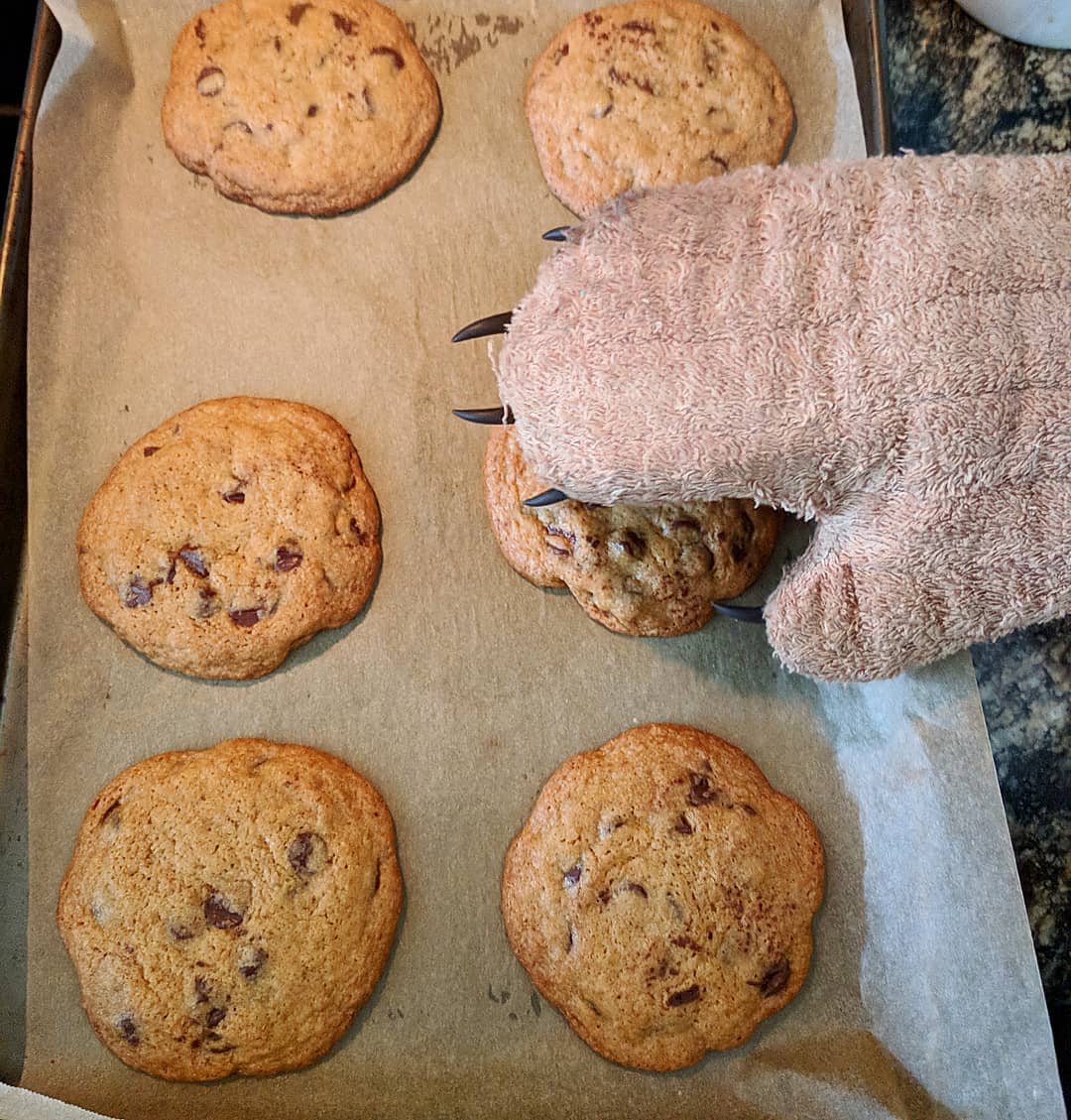
Chocolate Chip Cookies and Bear Hands
August 29, 2017 to December 31, 2017
“Working on pastry with my bear hands makes me happy”
“They tell me not to touch the cookies with my bear hands. But I guess I'm just a rebel and this rebel has claws.”
A tray of chocolate chip cookies, crinkled and golden, with a clawed bear-paw oven mitt reaching for one. They tell me not to touch the cookies with my bear hands. But I guess I'm just a rebel, and this rebel has claws. The mitts first appeared a few months earlier, gripping a rolling pin against a city skyline. Best purchase ever.
Behind the pun is a properly made cookie. The rippled surface and browned edges with a paler center are what you get from a dough with plenty of brown sugar, baked until the edges set and pulled while the middle is still soft. The chocolate chip cookie was invented by Ruth Wakefield at the Toll House Inn in Massachusetts in the 1930s.
This article is written in Corey’s voice for this tribute site, based on his captions and blog. His own words are the quotes above.
Rested Chocolate Chip Cookies
The chocolate chip cookie was created by Ruth Wakefield at the Toll House Inn in Whitman, Massachusetts, in the 1930s. This version follows the modern bakery approach made famous by Jacques Torres: a blend of two flours, large discs of dark chocolate, big portions and a long cold rest before baking.
Ingredients
Dough
- 240 g cake flour (2 cups minus 2 tablespoons)
- 240 g bread flour (1 2/3 cups)
- 6 g baking soda (1 1/4 teaspoons)
- 6 g baking powder (1 1/2 teaspoons)
- 8 g coarse or kosher salt (1 1/2 teaspoons)
- 280 g unsalted butter, cool room temperature (1 1/4 cups)
- 280 g light brown sugar (1 1/4 cups, packed)
- 225 g granulated sugar (1 cup plus 2 tablespoons)
- 2 large eggs (about 100 g without shells)
- 10 g pure vanilla extract (2 teaspoons)
- 560 g bittersweet chocolate discs or chopped bar chocolate, 60 to 70 percent cacao (1 1/4 pounds)
Finish
- Flaky sea salt, for sprinkling
Method
- Whisk the cake flour, bread flour, baking soda, baking powder and salt together in a bowl so the leaveners are evenly spread.
- Beat the butter with both sugars on medium speed for about 5 minutes, until pale and fluffy. Scrape the bowl, then add the eggs one at a time, followed by the vanilla.
- Add the dry ingredients on the lowest speed and stop as soon as the last streaks of flour disappear. Fold in the chocolate by hand so the discs stay whole.
- Press plastic wrap directly onto the dough and refrigerate for at least 24 hours and up to 72 hours. This recipe follows the long-rest method; 36 hours is the usual sweet spot.
- Heat the oven to 350°F (175°C) and line baking sheets with parchment. Scoop the cold dough into 100 g balls (about the size of a large golf ball), turning any chocolate discs flat so they sit horizontally, and space 6 to a sheet.
- Sprinkle each ball lightly with flaky salt. Bake one sheet at a time for 16 to 20 minutes, until the edges are golden brown and set but the centers still look pale and soft.
- Cool on the sheet for 10 minutes so the centers finish setting, then move to a rack. Serve slightly warm, when the chocolate is still fluid.
Chef’s notes
- If the cookies spread into thin puddles, the butter was too warm when creamed or the dough went into the oven warm. Portion the dough cold and chill the scooped balls for 15 minutes if the kitchen is hot.
- Rested dough is stiff. Let it sit at room temperature for 15 to 20 minutes before scooping, or portion the balls before the rest and store them covered.
- Chips are made to hold their shape and will not form the wide melted layers that discs or chopped bars do. If you only have chips, expect a more uniform, less layered cookie.
- Pull the cookies while the centers still look underdone. They firm up as they cool, and a cookie that looks finished in the oven will be dry an hour later.
Rest the dough or bake it today?
Rest 24 to 72 hours
Jacques Torres; the 2008 New York Times recipe reported by David Leite
A long cold rest lets the flour absorb the liquid from the eggs fully, which gives a drier, firmer dough that browns more evenly and tastes more of toffee and caramel. The main recipe here follows this method.
Bake the same day
The standard Nestlé Toll House package recipe; Sarah Kieffer's pan-banged cookies
Mixing and baking right away gives a softer, paler cookie with a cleaner butter and vanilla flavor, and it is how most home bakers have always made them. Its supporters argue that good technique and good chocolate matter more than a rest most people will not wait for.
Drawn from the methods of
- Jacques Torres, Jacques Torres Chocolate
- Stella Parks, BraveTart (2017)
- Dorie Greenspan, Dorie's Cookies (2016)
- King Arthur Baking Company
Corey has not published his own formula for this piece. This reference recipe is compiled from the published methods of the chefs and bakers listed above, written in our own words.