Free-Range Blackberries for Pie
August 19, 2017
“Prepping for pies”
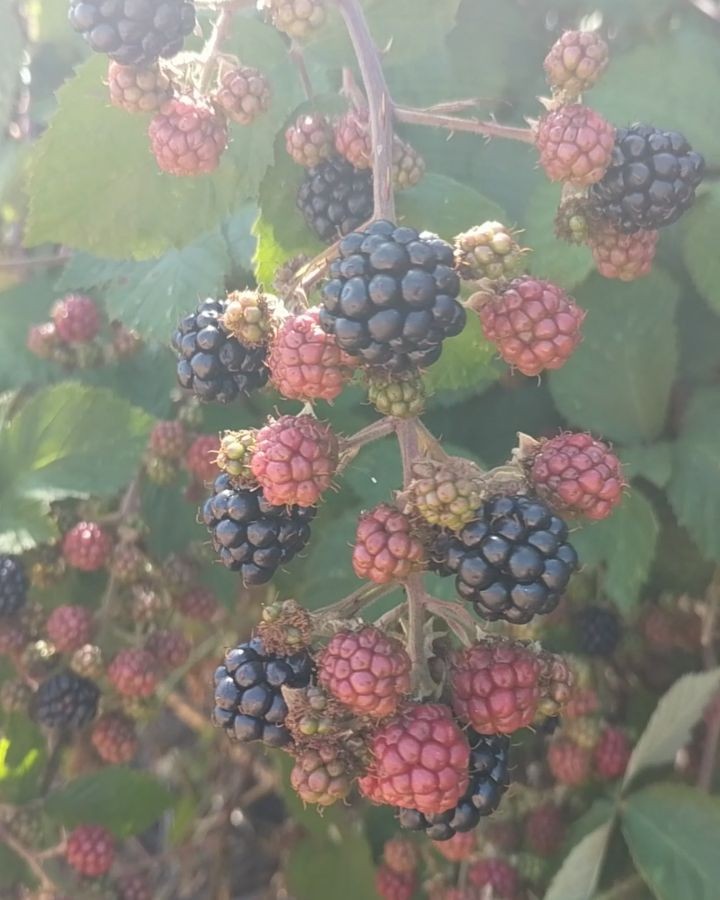
A bramble heavy with fruit at every stage, from green through red to glossy black. This was me prepping for pies with fresh, free-range blackberries.
Wild blackberries make a better pie than cultivated ones. They're smaller, sharper and more intensely flavored, and that acidity is what keeps a fruit pie from tasting flat. Only the fully black berries that pull away easily are ripe, since blackberries don't ripen after picking. A mix with a few slightly underripe berries adds pectin and helps the filling set. This post is a video on Instagram.
This article is written in Corey’s voice for this tribute site, based on his captions and blog. His own words are the quotes above.
Lattice-Top Blackberry Pie
A double-crust fruit pie is one of the oldest forms of American baking, and blackberry is among the most traditional fillings, made every summer wherever the brambles grow wild. This version uses an all-butter flaky dough, a lightly thickened filling that slices cleanly, and a woven lattice top that lets steam escape so the juices concentrate.
Ingredients
All-butter flaky pie dough
- 315 g all-purpose flour (2 1/2 cups)
- 15 g granulated sugar (1 tbsp)
- 6 g fine salt (1 tsp)
- 225 g cold unsalted butter, cut into 1.5 cm cubes (1 cup)
- 115 g ice water, plus more by the teaspoon if needed (1/2 cup)
Blackberry filling
- 900 g blackberries, fresh or frozen and not thawed (about 7 cups)
- 150 g granulated sugar (3/4 cup), up to 200 g for tart berries
- 35 g cornstarch (1/4 cup plus 1 tsp)
- 15 g lemon juice (1 tbsp)
- Finely grated zest of 1/2 lemon
- 1 g fine salt (1/4 tsp)
- 15 g unsalted butter, in small pieces (1 tbsp)
Finish
- 1 egg beaten with 1 tbsp milk or cream
- 15 g coarse or demerara sugar (1 tbsp)
Method
- Make the dough. Toss the butter in the flour, sugar and salt, then flatten each cube between your fingers, leaving pieces the size of walnut halves and large peas. Drizzle in the ice water and toss with a fork until shaggy clumps form.
- Press the dough together, divide in two, shape into disks and wrap. Chill at least 2 hours or overnight.
- Roll one disk to a 33 cm (13 inch) round and line a 9-inch (23 cm) pie plate, leaving the overhang. Roll the second disk to a 30 cm (12 inch) round and cut ten to twelve strips 2 cm (3/4 inch) wide. Chill both.
- Heat the oven to 425°F (220°C) with a rack in the lowest position and a baking sheet on it. Toss the berries with the sugar, cornstarch, lemon juice, zest and salt.
- Scrape the filling into the lined plate and dot with the butter. Lay half the strips across the pie, fold back every other strip, lay a cross strip, and unfold. Repeat, alternating, to weave the lattice.
- Trim the strips, fold the bottom overhang up over the ends and crimp. Chill the assembled pie 15 minutes, then brush the pastry with egg wash and sprinkle with coarse sugar.
- Bake on the hot sheet for 20 minutes, then lower the oven to 375°F (190°C) and bake 40-50 minutes more. The crust should be deep golden and the juices should bubble thickly in the centre, not just at the edge.
- Cool on a rack for at least 4 hours before cutting so the filling sets.
Chef’s notes
- A runny pie almost always came out too early. Cornstarch only thickens fully once the filling boils, so wait for slow, thick bubbles in the middle.
- If the dough softens while you weave, slide the whole pie into the refrigerator for 10 minutes. Warm butter means a tough, greasy crust.
- Baking low in the oven on a preheated sheet is the best insurance against a pale, soggy bottom crust.
- Shield the rim with a ring of foil if it browns before the centre bubbles.
All-butter crust or butter and shortening?
All-butter dough
Stella Parks, Claire Saffitz, Rose Levy Beranbaum, Erin Jeanne McDowell
Butter alone gives the best flavour and, handled cold with large flattened pieces, bakes into crisp, distinct layers. It softens quickly, so it asks for a cool kitchen and regular chilling. This recipe uses this method.
Butter and shortening or lard
King Arthur Baking Company, Julia Child, generations of American home bakers
Replacing a quarter to a half of the butter with shortening or lard raises the melting point of the fat, so the dough is easier to roll, holds crimps and lattice shapes better, and bakes up very tender. The trade is a milder, less buttery flavour.
Drawn from the methods of
- Rose Levy Beranbaum, The Pie and Pastry Bible (1998)
- Stella Parks, BraveTart (2017)
- Erin Jeanne McDowell, The Book on Pie (2020)
- King Arthur Baking Company
Corey has not published his own formula for this piece. This reference recipe is compiled from the published methods of the chefs and bakers listed above, written in our own words.