First Apple Hand Pies
January 24, 2018
“Some of my first attempt at an apple hand pie. Turned out fairly nice.”
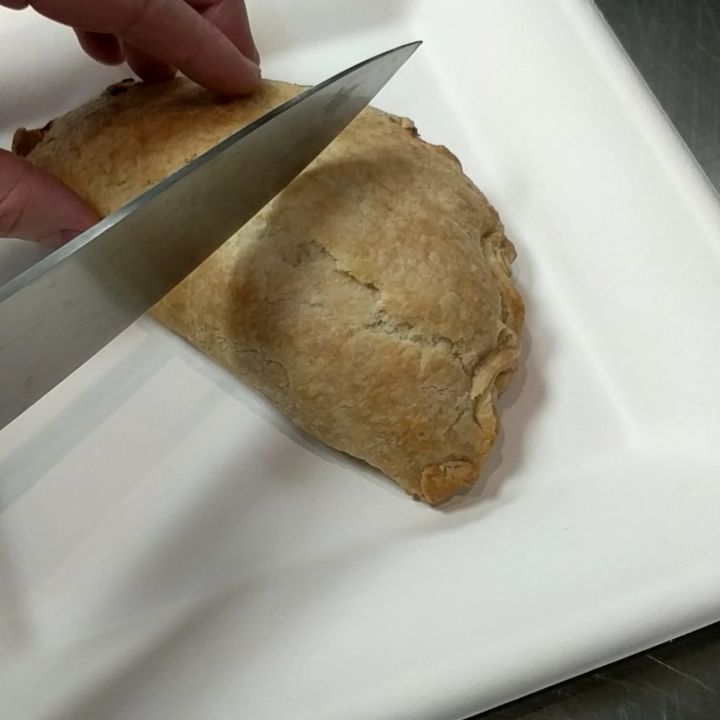
A golden half-moon hand pie on a white plate, its crimped edge and flaky crust about to meet a knife. This is some of my first attempt at an apple hand pie, and it turned out fairly nice.
The hand pie is the portable ancestor of the modern pie, related to the Cornish pasty, the empanada and the turnover. The challenge is keeping the filling inside. The apples are usually pre-cooked and cooled so they don't release juice and steam that would burst the seam, and the edges are sealed with egg wash and crimped. Small vents cut in the top let steam escape. This post is a video on Instagram.
This article is written in Corey’s voice for this tribute site, based on his captions and blog. His own words are the quotes above.
Apple Hand Pies
Hand pies are small, sealed turnovers made to be eaten without a plate, a tradition that runs from British pasties to the fried pies of the American South. These are baked, with a flaky all-butter crust and a pre-cooked cinnamon apple filling that stays thick, so the pastry bakes crisp and nothing leaks.
Ingredients
All-butter flaky pie dough
- 315 g all-purpose flour (2 1/2 cups)
- 15 g granulated sugar (1 tbsp)
- 6 g fine salt (1 tsp)
- 225 g cold unsalted butter, cubed (1 cup)
- 115 g ice water (1/2 cup)
Apple filling
- 450 g firm, tart apples such as Granny Smith or Honeycrisp, peeled and cut into 1 cm dice (3 medium)
- 20 g unsalted butter (1 1/2 tbsp)
- 60 g light brown sugar (1/4 cup, packed)
- 3 g ground cinnamon (1 tsp)
- Pinch of ground nutmeg and a pinch of salt
- 10 g lemon juice (2 tsp)
- 8 g cornstarch (1 tbsp) stirred into 15 g cold water (1 tbsp)
Finish
- 1 egg beaten with 1 tbsp milk or cream
- 20 g coarse or demerara sugar (1 1/2 tbsp)
Method
- Make the dough by flattening the cold butter into the flour, sugar and salt, leaving large flakes, then tossing with the ice water until it clumps. Divide in two, shape into disks and chill 2 hours.
- Melt the butter in a skillet over medium heat. Add the apples, brown sugar, cinnamon, nutmeg, salt and lemon juice and cook 6-8 minutes until the apples are just tender and the juices are syrupy.
- Stir in the cornstarch slurry and cook 1 minute more until thick and glossy. Spread on a plate and chill until completely cold.
- Roll each disk to 3 mm (1/8 inch) and cut 12 cm (5 inch) rounds, re-rolling scraps once, for 8 rounds in total. Chill the rounds on a parchment-lined sheet for 15 minutes.
- Place about 2 heaped tablespoons of filling on one half of each round, leaving a 1.5 cm (1/2 inch) border. Brush the border with egg wash, fold over to make a half-moon, press out the air and seal firmly with the tines of a fork.
- Freeze the pies 20 minutes. Heat the oven to 400°F (200°C).
- Brush with egg wash, sprinkle with coarse sugar and cut two or three small steam vents in each.
- Bake 22-28 minutes, rotating the sheet once, until deep golden brown and the filling bubbles through the vents. Cool on a rack at least 15 minutes before eating.
Chef’s notes
- Leaks come from overfilling, a weak seal or warm dough. Keep the border clean, press hard, and freeze the pies before baking.
- The filling must be cold when it goes in. Warm filling melts the butter in the dough and the crust bakes greasy instead of flaky.
- Dicing the apples small matters. Large chunks tear the dough and leave air pockets.
- For a glazed finish, skip the coarse sugar and drizzle cooled pies with 100 g powdered sugar mixed with 20 g milk or apple cider.
Drawn from the methods of
- Erin Jeanne McDowell, The Book on Pie (2020)
- Stella Parks, BraveTart (2017)
- King Arthur Baking Company
Corey has not published his own formula for this piece. This reference recipe is compiled from the published methods of the chefs and bakers listed above, written in our own words.