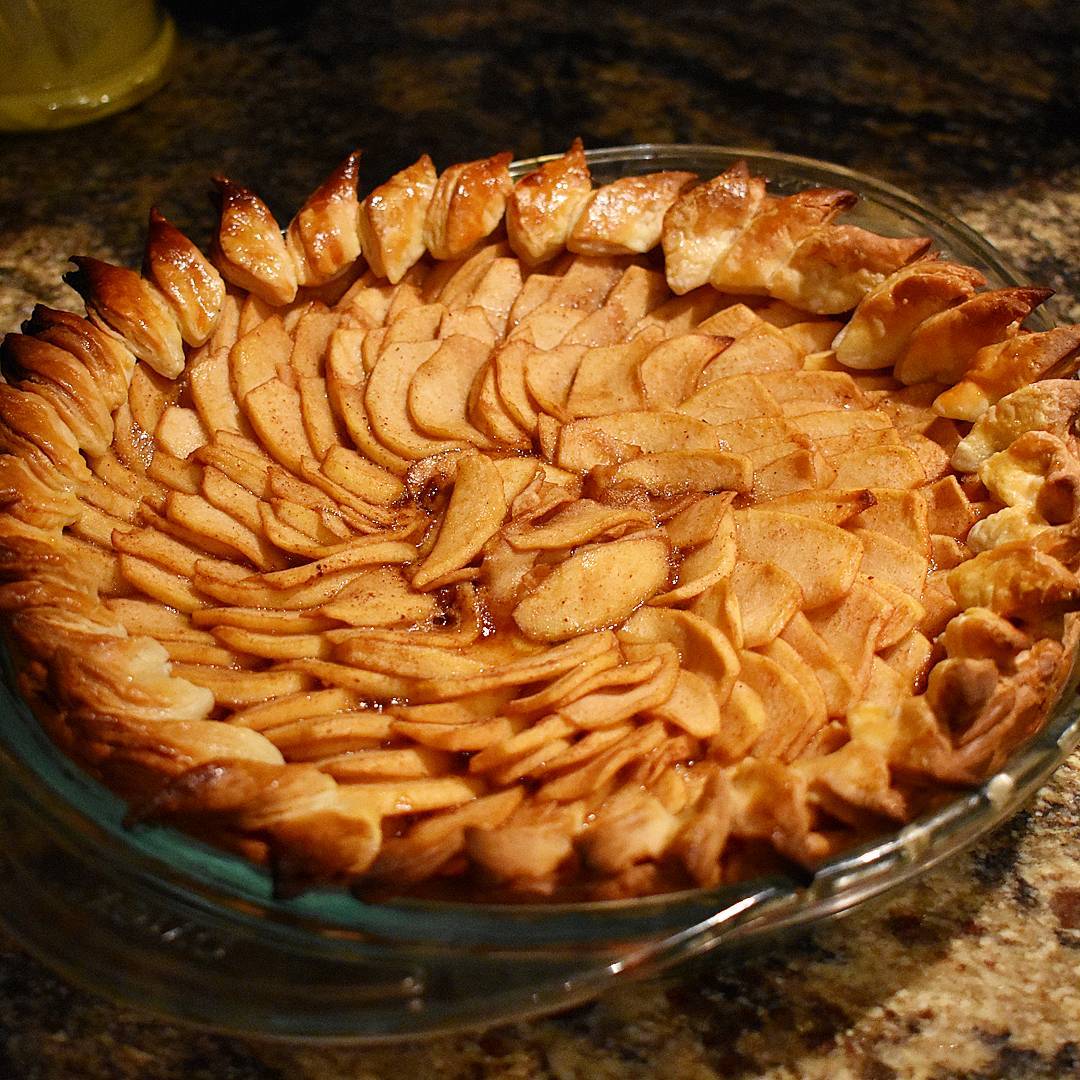
The Open-Faced "Designer" Apple Pie
July 21, 2017
“First attempt at an open faced "designer" apple pie”
My first attempt at an open-faced "designer" apple pie. I tried. Hundreds of thin apple slices arranged in tight concentric rings in a glass pie dish, the outer ring standing up like petals, all dusted with cinnamon and baked until the edges caramelize.
This is closer to the French tarte aux pommes than the American double-crust pie. You slice the apples as thinly and evenly as possible and overlap them like roof tiles in a spiral from the outside in. The second photo, a close-up, shows how the tips have crisped and browned. A final brush of warm apricot glaze is the traditional finish.
This article is written in Corey’s voice for this tribute site, based on his captions and blog. His own words are the quotes above.
French Apple Tart (Tarte aux Pommes)
The open-faced French apple tart shows its fruit: paper-thin apple slices are fanned in overlapping circles over a buttery crust and glazed with apricot. This version follows the classic bistro and home-kitchen form, with a layer of lightly sweetened apple compote under the slices to keep the tart moist and intensely flavoured.
Ingredients
Pâte brisée
- 200 g all-purpose flour (1 2/3 cups)
- 15 g granulated sugar (1 tbsp)
- 3 g fine salt (1/2 tsp)
- 130 g cold unsalted butter, cubed (9 tbsp)
- 50-60 g ice water (3 1/2 to 4 tbsp)
Apple compote
- 450 g apples, peeled, cored and roughly chopped (3 medium)
- 30 g granulated sugar (2 1/2 tbsp)
- 30 g water (2 tbsp)
- 15 g unsalted butter (1 tbsp)
- 1/2 vanilla bean, split, or 1 tsp vanilla extract
- 10 g lemon juice (2 tsp)
Apple topping
- 600 g firm apples such as Golden Delicious, Braeburn or Pink Lady (4 medium)
- 30 g unsalted butter, melted (2 tbsp)
- 25 g granulated sugar (2 tbsp)
Glaze
- 80 g apricot jam (1/4 cup)
- 15 g water or Calvados (1 tbsp)
Method
- Make the dough: rub the butter into the flour, sugar and salt until the largest pieces are the size of peas, add the ice water and press together. Shape into a disk and chill at least 1 hour.
- For the compote, cook the chopped apples with the sugar, water, butter and vanilla, covered, over medium-low heat for 15 minutes until soft. Uncover, mash and cook until thick and fairly dry, then stir in the lemon juice and cool.
- Roll the dough to 3 mm (1/8 inch) and line a 10-inch (25 cm) tart pan with a removable bottom. Prick the base and chill 30 minutes. Heat the oven to 375°F (190°C) with a rack in the lower third.
- Spread the cooled compote evenly over the raw dough.
- Peel, halve and core the topping apples, then slice them crosswise as thinly as you can, about 2 mm (1/16 inch), keeping each half together.
- Starting at the outer edge, fan the slices in a tightly overlapping circle with the rounded sides facing out. Continue with smaller circles toward the centre to form a spiral, and finish with a small rosette.
- Brush the apples with the melted butter and sprinkle with the sugar.
- Bake 55-65 minutes, until the crust is deep golden and the apple edges are browned and caramelised.
- Warm the jam with the water, strain, and brush it over the hot apples. Unmould once the tart has cooled for 20 minutes and serve warm or at room temperature.
Chef’s notes
- Slice thickness decides the look. Thick slices will not bend into a fan and they shrink apart in the oven, so overlap them more than seems necessary.
- A wet compote makes a soggy base. Cook it until a spoon dragged through leaves a trail that holds.
- Choose apples that keep their shape. Soft varieties such as McIntosh collapse and lose the pattern.
- If the edges are pale at the end, a minute or two under the broiler adds colour. Watch it closely.
Compote under the apples, or apples straight on the dough?
Compote base
Julia Child, classical French pâtisserie, Ferrandi Paris
A layer of thick apple compote goes under the sliced fruit. It adds a second, deeper apple flavour, keeps the tart moist and gives the slices something to grip. This recipe uses this method.
Tarte fine, no compote
Jacques Pépin's thin apple galette, many Paris bistros
Apple slices are laid directly on very thin pastry, often puff or a free-form galette dough, with only butter and sugar. The tart is thinner, crisper and more caramelised, with a higher ratio of pastry to fruit.
Drawn from the methods of
- Julia Child, Louisette Bertholle and Simone Beck, Mastering the Art of French Cooking (1961)
- Jacques Pépin, Essential Pépin (2011)
- Ferrandi Paris, French Pâtisserie (2017)
Corey has not published his own formula for this piece. This reference recipe is compiled from the published methods of the chefs and bakers listed above, written in our own words.