Orange Hot Milk Sponge Cake
August 13, 2017
“Orange hot milk sponge cake”
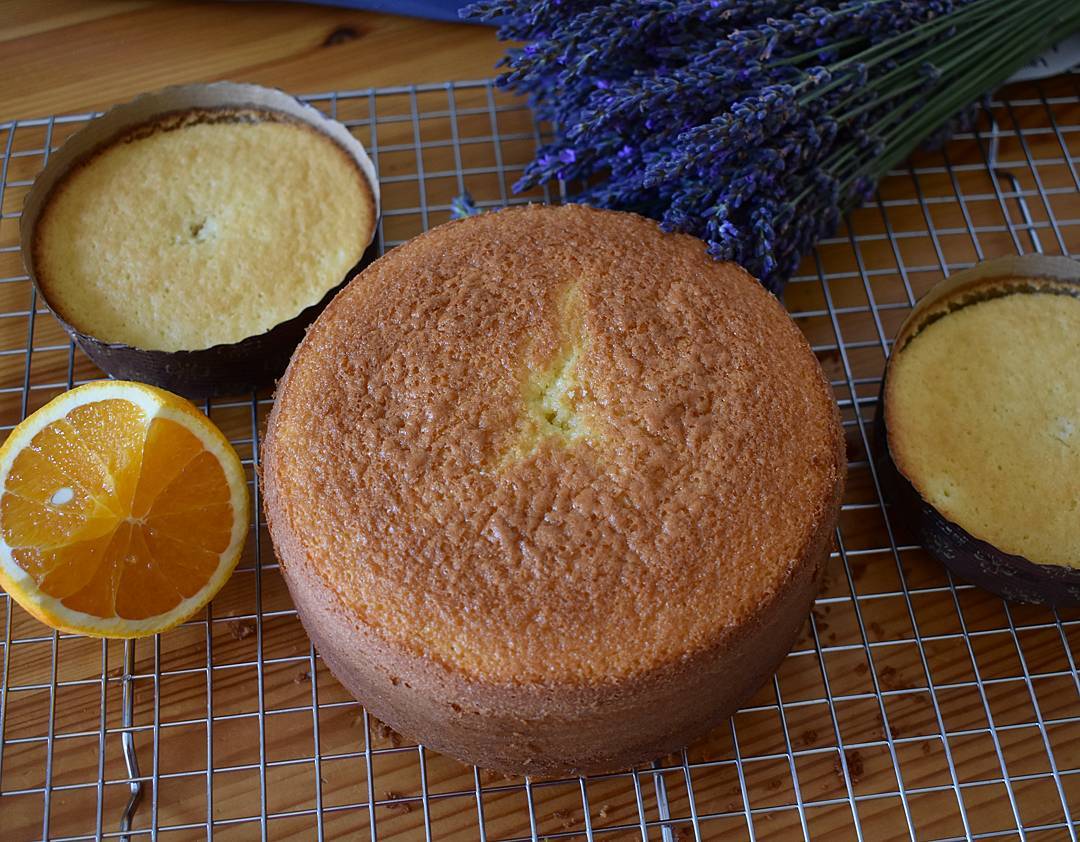
A single round of golden sponge cooling on a wire rack, with a bundle of fresh lavender and a cut orange beside it. The crust is fine and even, the dome slight.
Hot milk sponge is a classic American cake from the early twentieth century and a favorite of mine: I come back to it again and again. Eggs and sugar are whipped to a thick foam, flour is folded in, and then milk heated with butter is stirred through. The hot liquid gives a fine, moist, close crumb that is sturdier than a French génoise and takes flavorings such as orange zest well. This is the sponge I later chose for my job application cake.
This article is written in Corey’s voice for this tribute site, based on his captions and blog. His own words are the quotes above.
Hot Milk Sponge Cake
Hot milk sponge is an old-fashioned American cake that turns up in community cookbooks and newspaper columns from the early twentieth century onward. Whole eggs are whipped with sugar until thick, then scalded milk and a little butter are stirred in, which gives a fine, velvety crumb that is sturdier and moister than a classic genoise. It is the traditional base for Boston cream pie and a fine cake to eat plain.
Ingredients
Sponge
- 240 g all-purpose flour (2 cups)
- 2 tsp baking powder
- 1/2 tsp fine salt
- 4 large eggs, at room temperature
- 300 g granulated sugar (1 1/2 cups)
- 2 tsp vanilla extract
- 240 g whole milk (1 cup)
- 85 g unsalted butter (6 Tbsp)
Orange variation
- Finely grated zest of 2 oranges, rubbed into the sugar
- 1/2 tsp orange blossom water or 1/4 tsp orange oil (optional), in place of 1 tsp of the vanilla
- 120 g powdered sugar (1 cup)
- 30 g fresh orange juice (2 Tbsp)
Method
- Heat the oven to 350°F (175°C). Grease two 9-inch (23 cm) round pans or one 9 x 13-inch (23 x 33 cm) pan and line the bases with parchment.
- Sift the flour, baking powder and salt together twice.
- Whip the eggs and sugar on high speed until very thick, pale and tripled in volume, 6-8 minutes. The foam should fall in a ribbon that sits on the surface for several seconds. Beat in the vanilla.
- Meanwhile heat the milk and butter until the butter melts and the milk is steaming with small bubbles at the edge, about 82°C (180°F). Keep it hot.
- Sift the dry ingredients over the egg foam in three additions, folding gently with a large whisk or spatula just until the flour disappears.
- Pour the hot milk down the side of the bowl in a steady stream while folding, and continue just until the batter is smooth. It will be thin and pourable.
- Pour straight into the pans and bake at once: 25-30 minutes for rounds, 30-35 minutes for the sheet, until golden, springy and just pulling from the sides.
- Cool in the pans 10 minutes, then turn out onto a rack and cool completely.
- For the orange variation, rub the zest into the sugar with your fingertips before whipping it with the eggs. Whisk the powdered sugar with the orange juice and pour the glaze over the cooled cake.
Chef’s notes
- The milk must be genuinely hot when it goes in. Lukewarm milk gives a heavy, rubbery layer at the bottom, because the heat is what starts the batter setting and keeps the butter fluid.
- Under-whipped eggs are the usual cause of a flat cake. Whip for the full time, until the ribbon holds.
- Work fast once the milk is in. The baking powder is already active and the foam loses volume every minute the batter waits.
- Do not replace the milk with orange juice in the variation, because acid curdles hot milk. Flavor with zest in the batter and juice in the glaze.
Drawn from the methods of
- King Arthur Baking Company
- Tish Boyle, The Cake Book (2006)
- Stella Parks, BraveTart (2017)
Corey has not published his own formula for this piece. This reference recipe is compiled from the published methods of the chefs and bakers listed above, written in our own words.