Challah, Braided with a Little Help
October 5, 2019
“Let me just say I suck at braiding but with a little help from @crownroyaleequestrian I was able to do an okay job.”
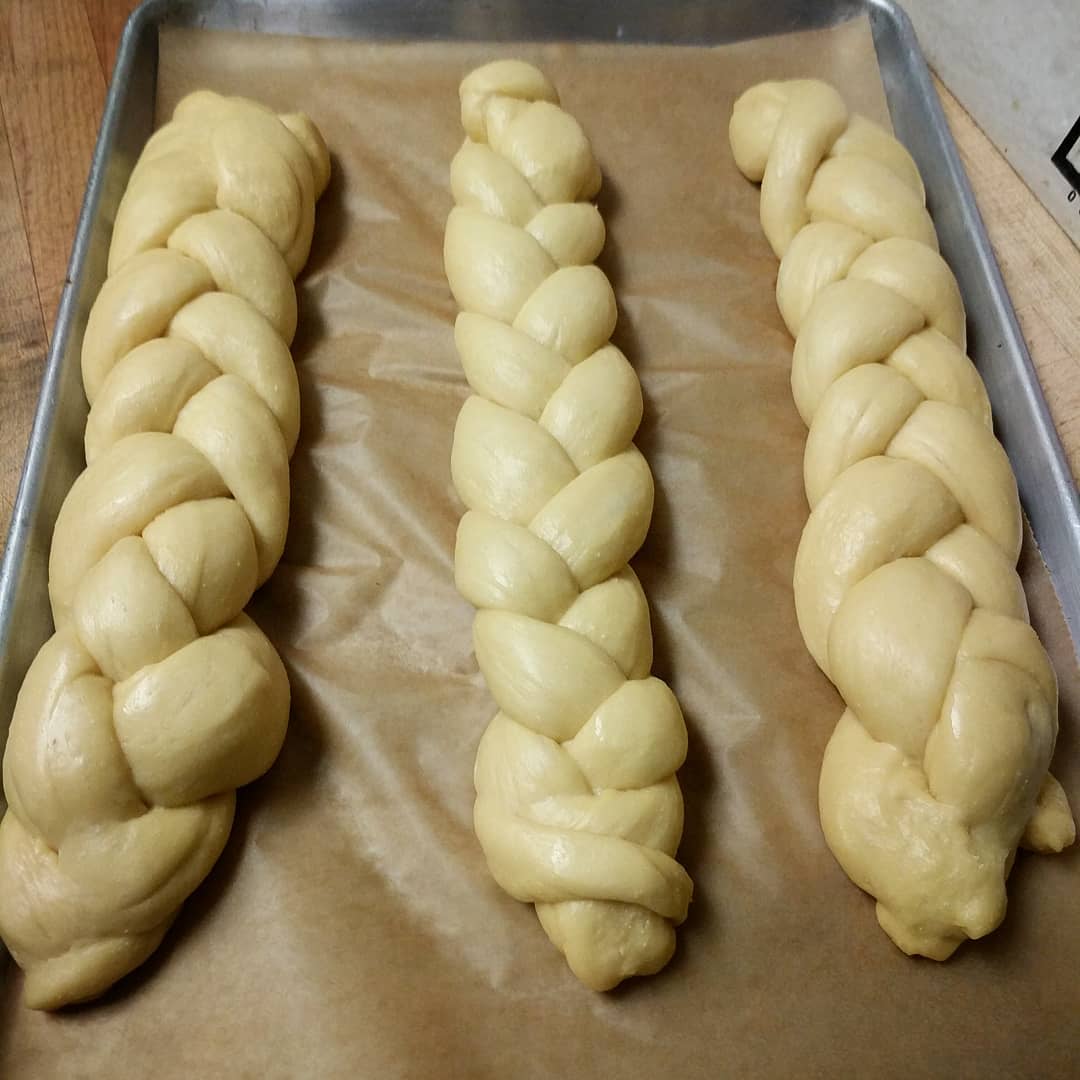
Let me just say I suck at braiding. These are three long braided loaves on a tray, egg-washed and proofed, ready to bake. I owe the braiding lesson to a friend from the horse world, which makes sense: anyone who can braid manes can braid dough.
Challah is the enriched bread of the Jewish Sabbath and holidays, made with eggs and oil instead of butter and milk so that it can be eaten with any meal under kosher rules. The braid is more than decoration, since it gives the loaf its characteristic pull-apart strands. The keys are even strands rolled to the same length, braided loosely so they have room to expand, and two coats of egg wash for a deep mahogany shine.
This article is written in Corey’s voice for this tribute site, based on his captions and blog. His own words are the quotes above.
Braided Challah
Challah is the braided egg bread of the Jewish Sabbath and holidays. The braided form developed among Ashkenazi Jews in central Europe in the Middle Ages. It is made with oil in place of butter so that it can be served with a meat meal under kosher law.
Ingredients
Dough
- 500 g bread flour (about 4 cups)
- 170 g lukewarm water (3/4 cup)
- 100 g eggs (2 large)
- 20 g egg yolk (1 large)
- 60 g neutral oil or mild olive oil (1/4 cup plus 1 tsp)
- 60 g honey (3 tbsp), or 50 g sugar (1/4 cup)
- 10 g fine sea salt (1 3/4 tsp)
- 8 g instant yeast (2 1/2 tsp)
Finish
- 1 egg beaten with a pinch of salt, for egg wash
- Sesame or poppy seeds, optional
Method
- Mix all the dough ingredients on low speed for 3 minutes, then knead on medium for 6 to 8 minutes, until smooth and firm. Challah dough is stiffer than most enriched doughs. That firmness is what keeps the braid sharply defined.
- Cover and let rise at room temperature for 1 1/2 to 2 hours, until doubled. For more flavour, refrigerate overnight instead and shape it cold.
- Divide into 6 equal pieces of about 155 g for a six-strand braid, or 3 pieces for a simple braid. Flatten each piece, roll it up tightly into a cylinder, and rest covered for 10 minutes.
- Roll each piece into a 40 cm (16 in) rope, thicker in the middle and tapered at the ends. Use no flour on the bench, since the ropes need grip to lengthen.
- For a three-strand braid, pinch the tops together and braid as you would hair. For six strands, pinch the tops together and fan the ropes out, then take the rope on the far right and carry it over two, under one, and over two. Repeat, always starting with the rope now on the far right, until the ropes run out. Pinch the ends and tuck both ends under.
- Set on a parchment-lined tray, brush with egg wash, and proof for 1 to 1 1/2 hours, until the loaf is puffy and a gentle poke springs back slowly.
- Brush with egg wash a second time, getting into the creases, and sprinkle with seeds if you like. Bake at 350°F (175°C) for 30 to 35 minutes, turning the tray halfway, until deep mahogany and 190°F (88°C) inside.
- Cool completely on a rack before slicing.
Chef’s notes
- Pale stripes in the creases appear when the braid expands in the oven after egg washing. Two coats of wash, the second just before baking, keep the colour even.
- A braid that tears or loses its shape was underproofed. Give it the full final rise.
- Braid loosely. The strands need room to expand, and a tight braid splits along its sides.
- For Rosh Hashanah, add 100 g (2/3 cup) raisins and coil a single long rope into a round spiral.
Drawn from the methods of
- Maggie Glezer, A Blessing of Bread (2004)
- Peter Reinhart, The Bread Baker's Apprentice (2001)
- Rose Levy Beranbaum, The Bread Bible (2003)
Corey has not published his own formula for this piece. This reference recipe is compiled from the published methods of the chefs and bakers listed above, written in our own words.