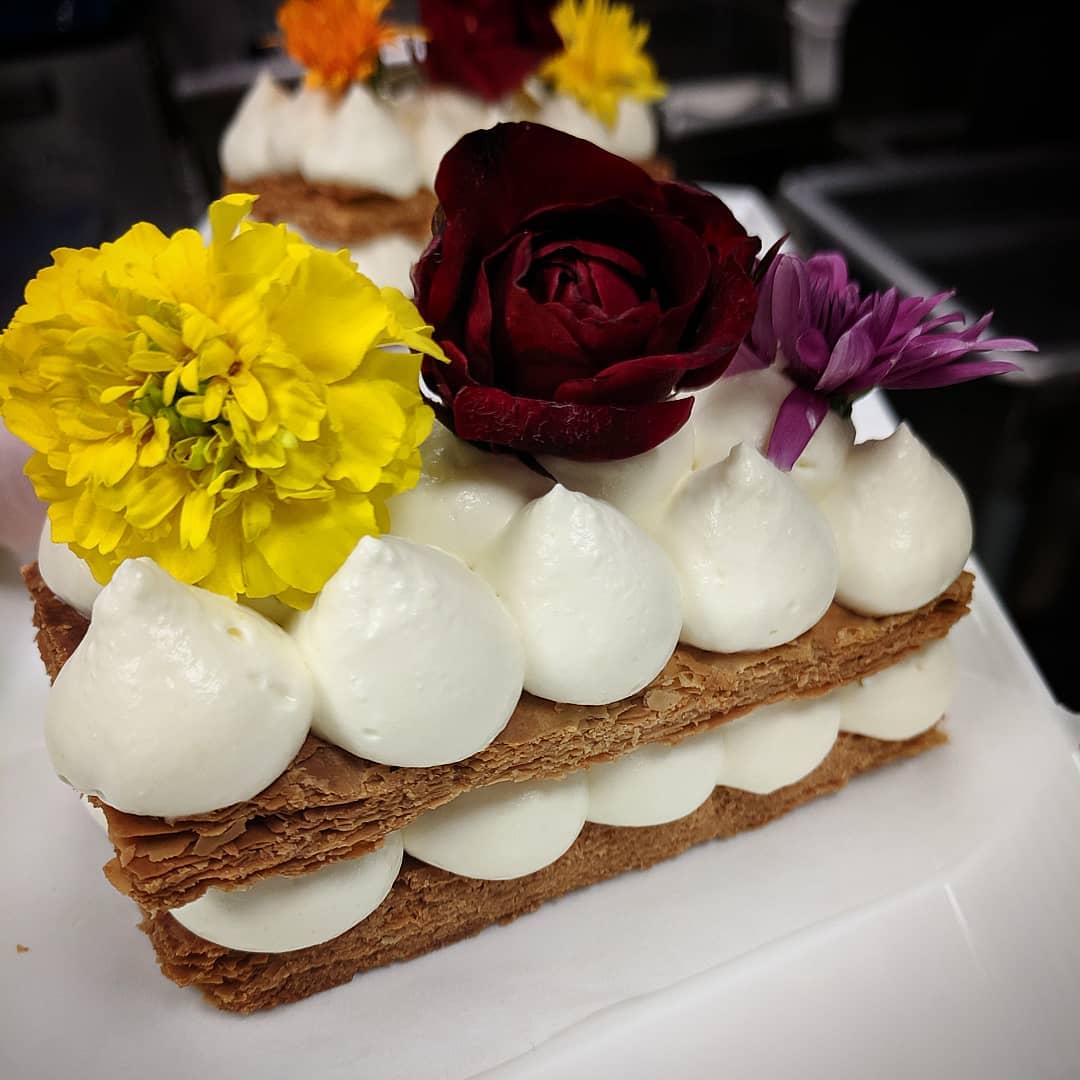
Lemon Cream Mille-Feuille
October 9, 2019
“Lemon cream millefeuille, I cheated a bit and used quick puff pastry but it came out pretty well.”
A slice of mille-feuille with two tiers of caramelized puff pastry, rows of piped lemon cream in neat peaked domes, and a crown of fresh flowers: a yellow marigold, a deep red rose, a purple bloom. I'll admit I cheated a bit and used quick puff pastry, but it came out pretty well.
Mille-feuille means a thousand leaves. The pastry is baked between two trays so it rises evenly and stays flat, then it's often dusted with sugar and returned to the oven to caramelize, which keeps it crisp under the cream. Piping the cream in rows of rounds, in place of spreading it, is the modern Paris style. And quick puff is not really cheating: plenty of professionals use it for exactly this.
This article is written in Corey’s voice for this tribute site, based on his captions and blog. His own words are the quotes above.
Mille-Feuille with Lemon Cream Variation
Mille-feuille, a thousand leaves, is three layers of crisp caramelised puff pastry stacked with pastry cream. Versions have appeared in French cookbooks since at least the 18th century, and Marie-Antoine Carême, writing in the early 1800s, already treated it as an old recipe. In the United States it is usually called a Napoleon.
Ingredients
Pastry
- 500 g all-butter puff pastry, classic or rough puff (about 1 lb)
- 40 g powdered sugar, for caramelising (1/3 cup)
Vanilla pastry cream
- 500 g whole milk (2 cups plus 1 tbsp)
- 1 vanilla bean, split and scraped, or 2 tsp vanilla paste
- 110 g egg yolks (6 large)
- 100 g granulated sugar (1/2 cup)
- 45 g cornstarch (1/3 cup)
- 40 g unsalted butter, cubed (3 tbsp)
Lemon cream variation (replaces the pastry cream)
- 150 g eggs (3 large)
- 150 g granulated sugar (3/4 cup)
- Finely grated zest of 3 lemons
- 120 g fresh lemon juice (1/2 cup, about 3 lemons)
- 200 g unsalted butter, soft, in pieces (14 tbsp)
Finish
- Powdered sugar, for dusting
Method
- Roll the pastry to a 30 x 40 cm (12 x 16 in) rectangle about 2 mm thick. Lift it onto a parchment-lined baking sheet, prick it all over with a fork, and chill for at least 1 hour so it will not shrink.
- Heat the oven to 375°F (190°C). Cover the pastry with a second sheet of parchment and a second baking sheet to weigh it down. Bake for 25 to 30 minutes, until evenly golden right through. The weight keeps the layers thin, flat and crisp.
- Raise the oven to 450°F (230°C). Remove the top tray and parchment, dust the pastry evenly with the powdered sugar, and return it to the oven for 3 to 5 minutes, watching closely, until the sugar melts into a glossy amber glaze. Cool completely.
- For the pastry cream, bring the milk and vanilla to a simmer. Whisk the yolks, sugar and cornstarch until smooth, whisk in the hot milk, return everything to the pan, and cook over medium heat, whisking hard, until it has boiled for a full 1 to 2 minutes. Off the heat, whisk in the butter. Press plastic wrap on the surface and chill until cold, at least 2 hours.
- For the lemon cream variation, rub the zest into the sugar, whisk in the eggs and juice, and cook in a bowl over simmering water, whisking, until it thickens at 180°F (82°C). Strain, cool to 140°F (60°C), then blend in the butter a piece at a time with an immersion blender until smooth and pale. Chill for at least 4 hours, until firm enough to pipe.
- With a serrated knife and a gentle sawing motion, trim the pastry edges and cut it lengthwise into 3 equal strips, each about 10 cm (4 in) wide.
- Whisk the cold pastry cream until smooth and put it in a piping bag with a 12 mm (1/2 in) plain tip. Pipe rows of bulbs over one strip, glazed side up, top with a second strip, pipe again, and finish with the third strip, glazed side up.
- Chill the assembled strip for 30 minutes to firm up. Cut into 6 pastries with a serrated knife, sawing through the top layer without pressing, and wiping the blade between cuts.
- Dust with powdered sugar and serve within 4 hours, while the pastry is still crisp.
Chef’s notes
- Soggy pastry is the enemy. Bake it darker than seems right, caramelise it so the sugar glaze acts as a moisture barrier, and assemble as close to serving as you can.
- If the cream squeezes out when you cut, it was too soft or the knife was pushed, not sawed. Boil the pastry cream for the full time so the starch sets firmly. Some chefs cut the top layer into portions before placing it.
- Pastry that shrinks or buckles was not rested. An hour in the refrigerator, or overnight, after rolling makes all the difference.
- Watch the caramelising step without leaving the oven. The sugar goes from glossy to burnt in under a minute.
Straight pastry cream or a lightened cream?
Classic pastry cream
Le Cordon Bleu, Bo Friberg, traditional French pâtisseries
A firm vanilla pastry cream is used on its own, as in the traditional recipe. It has the purest custard flavour and holds a clean edge when cut, and it is the method this recipe follows.
Diplomat or mousseline cream
Many contemporary Paris pastry chefs; Pierre Hermé's 2000 Feuilles uses a praline mousseline
The pastry cream is lightened with whipped cream and set with a little gelatin (diplomat), or enriched with whipped butter (mousseline). The result is airier and more luxurious, and it can be piped taller, but it softens the pastry faster.
Drawn from the methods of
- Ferrandi Paris, French Pâtisserie (2017)
- Pierre Hermé
- Bo Friberg, The Professional Pastry Chef
- Le Cordon Bleu
Corey has not published his own formula for this piece. This reference recipe is compiled from the published methods of the chefs and bakers listed above, written in our own words.