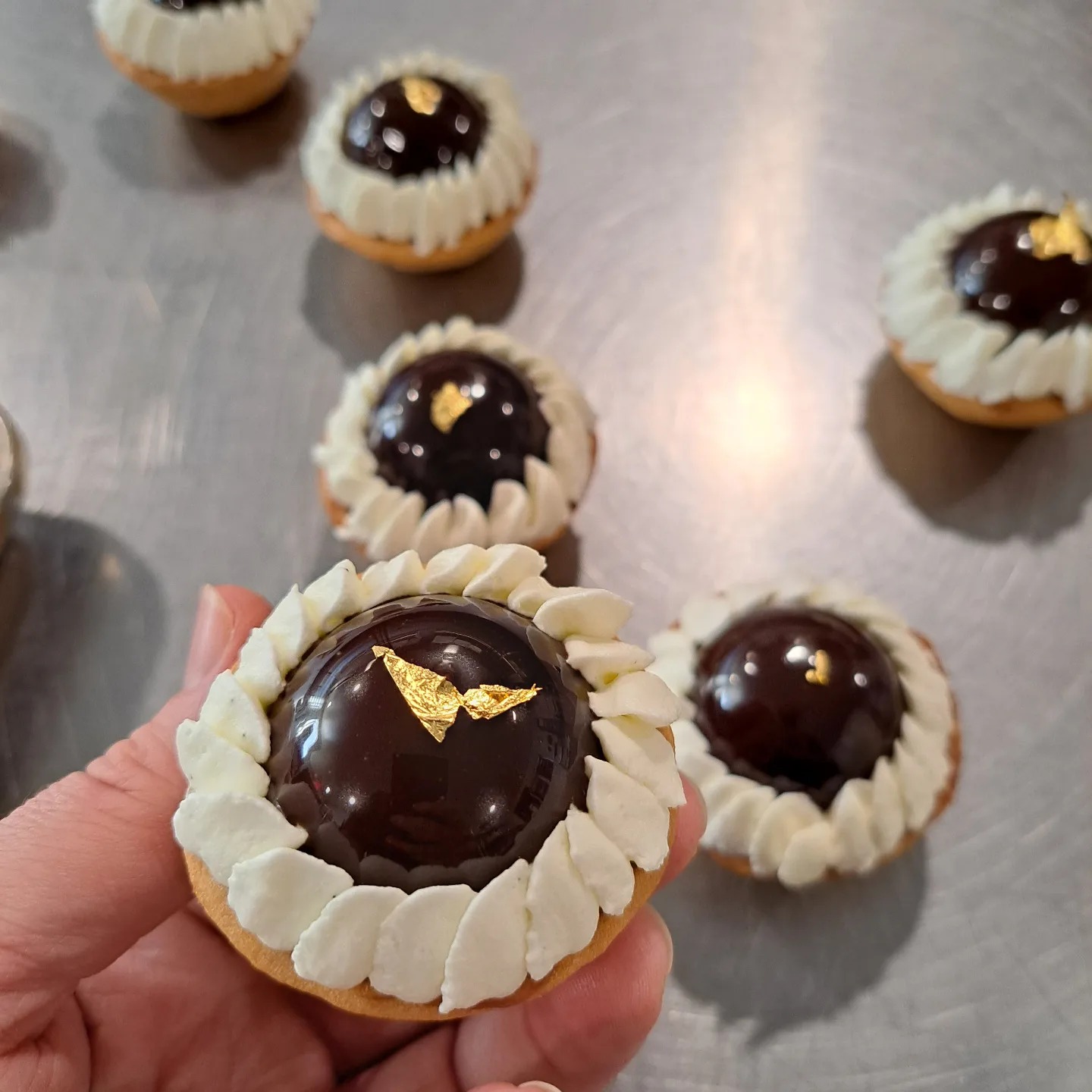
Petite Chocolate Tartlets with Gold Leaf
October 21, 2024
“Petite pastries, so cute and yet so frustrating.”
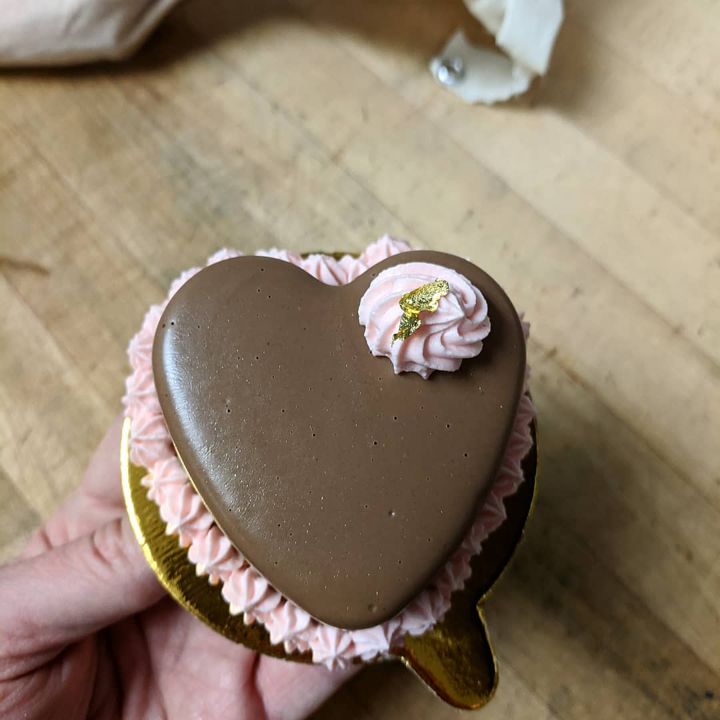
Petite pastries: so cute and yet so frustrating. These are tiny tart shells, each carrying a glossy dark chocolate dome, a ring of cream piped in individual petals, and a fleck of gold leaf placed dead center.
Everything about miniature pastry is harder than it looks. The shells are thin and break easily, the dome has to be glazed without a single drip, and each petal of cream is a separate squeeze of the piping bag at a scale where a millimeter shows. Work like this is called petits gâteaux or petits fours depending on size, and it is where a pastry kitchen shows its discipline. I put the gold leaf on with the tip of a knife or tweezers, because otherwise it clings to your fingers.
This article is written in Corey’s voice for this tribute site, based on his captions and blog. His own words are the quotes above.
Chocolate Ganache Tartlets
Petite chocolate tartlets in the style of a French pâtisserie case: a thin chocolate sablé shell filled with dark ganache, crowned with a moulded ganache dome, ringed with piped cream and finished with a touch of gold leaf. The components are simple, and the result depends on precise temperatures and neat finishing.
Ingredients
Chocolate sablé
- 200 g all-purpose flour (1 2/3 cups)
- 30 g Dutch-process cocoa powder (1/3 cup)
- 30 g almond flour (1/3 cup)
- 90 g powdered sugar (3/4 cup)
- 2 g fine salt (1/3 tsp)
- 130 g unsalted butter, soft but cool (9 tbsp)
- 50 g egg (1 large)
Dark chocolate ganache (filling and domes)
- 300 g dark chocolate, 64-70% cacao, finely chopped (10 1/2 oz)
- 300 g heavy cream (1 1/4 cups)
- 30 g honey or glucose syrup (1 1/2 tbsp)
- 50 g unsalted butter, soft (3 1/2 tbsp)
- Pinch of fine salt
Vanilla mascarpone cream
- 200 g heavy cream, very cold (3/4 cup plus 2 tbsp)
- 60 g mascarpone, cold (1/4 cup)
- 25 g powdered sugar (3 tbsp)
- Seeds of 1/2 vanilla bean
Finish
- Edible gold leaf
- Cocoa powder for dusting the domes (optional)
Method
- Make the sablé: beat the butter, powdered sugar and salt until smooth, add the almond flour and egg, then the sifted flour and cocoa. Wrap and chill 2 hours.
- Roll to 2-3 mm (a scant 1/8 inch) and line twelve 7 cm (2.75 inch) tartlet rings or tins. Prick the bases and freeze 20 minutes.
- Bake at 325°F (165°C) for 15-18 minutes until dry, matte and firm. Cool completely.
- For the ganache, bring the cream, honey and salt just to a simmer and pour over the chocolate. Wait 1 minute, stir from the centre until smooth, then blend in the butter once the ganache is about 95-104°F (35-40°C).
- Fill twelve 4 cm (1.5 inch) silicone half-sphere moulds with ganache and freeze until solid, at least 4 hours. Pour the remaining ganache into the shells, filling them level with the rim, and chill until set.
- Whip the cream, mascarpone, powdered sugar and vanilla together to medium-firm peaks. Transfer to a piping bag fitted with a small star or plain tip.
- Unmould the frozen domes and set one in the centre of each tartlet. Dust the domes with cocoa if you like a velvet look, or leave them glossy.
- Pipe a border of small shells or dots of cream around each dome. Place a fleck of gold leaf on top with the tip of a small knife or tweezers.
- Let the tartlets stand in the refrigerator for 1 hour so the domes thaw to a soft, truffle-like texture before serving.
Chef’s notes
- Domes will only release cleanly if frozen hard. If they stick, give them another hour.
- Condensation forms on the domes as they thaw. Thaw them in the refrigerator, not at room temperature, to keep the surface clean.
- Gold leaf clings to fingers and dissolves on wet tools. Handle it with dry tweezers or a dry brush, away from drafts.
- Unfilled shells keep 5 days in an airtight tin, so the work can be spread across two days.
Drawn from the methods of
- Pierre Hermé and Dorie Greenspan, Chocolate Desserts by Pierre Hermé (2001)
- Ferrandi Paris, French Pâtisserie (2017)
- Thomas Keller and Sebastien Rouxel, Bouchon Bakery (2012)
Corey has not published his own formula for this piece. This reference recipe is compiled from the published methods of the chefs and bakers listed above, written in our own words.