Toffee "Blood" for Halloween
October 23, 2019
“Made a bunch of toffee (blood) for an event.”
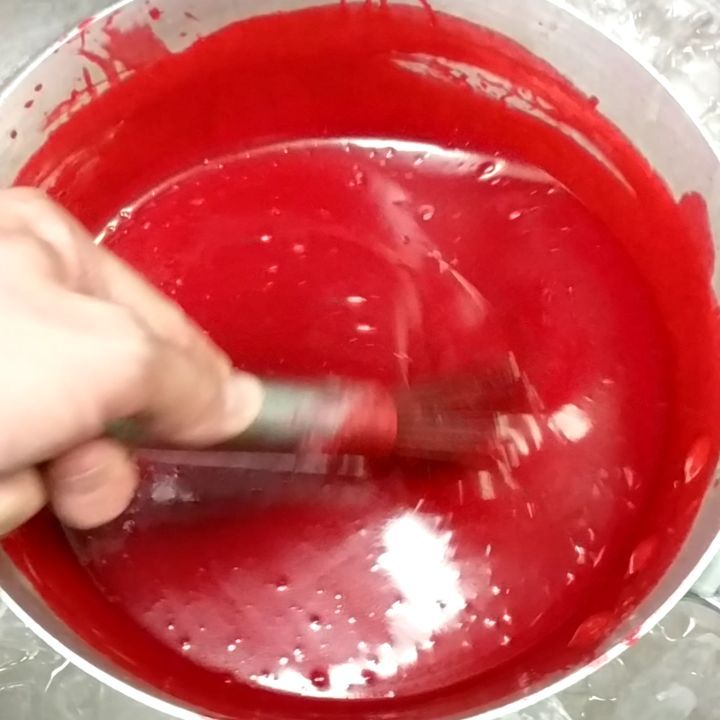
I made a bunch of toffee (blood) for an event. It's a bowl of glossy, vividly red cooked sugar that I'm stirring with a brush, and it's viscous enough to hold a trail. I tagged it #makesmeuncomfortable, which seems about right.
Edible stage blood for desserts is a sugar-work job. You cook sugar syrup to the stage that gives the thickness you want, color it red, and use it warm to drip down cakes or cool it into shards. The stage of cooking decides everything: a few degrees separate a pourable syrup from a brittle candy, which is why a sugar thermometer is the one tool you cannot skip. This post is a video on Instagram.
This article is written in Corey’s voice for this tribute site, based on his captions and blog. His own words are the quotes above.
Cooked Sugar Stages and Butter Toffee
All sugar confectionery rests on one fact: as a syrup boils, water leaves, the temperature rises and the cooled result gets steadily harder, from a soft ball to brittle glass. Butter toffee, an English sweet that appears in print in the early 19th century, is sugar and butter cooked together to the hard crack stage. This recipe walks through the stages, makes a classic almond butter toffee and ends with a note on tinting sugar syrup red for edible stage blood.
Ingredients
Butter toffee
- 225 g unsalted butter, cut into pieces (1 cup)
- 200 g granulated sugar (1 cup)
- 30 g water (2 tablespoons)
- 20 g light corn syrup or glucose (1 tablespoon)
- 3 g fine sea salt (1/2 teaspoon)
- 5 g pure vanilla extract (1 teaspoon)
Topping
- 170 g dark chocolate, finely chopped (6 ounces)
- 100 g almonds, toasted and finely chopped (3/4 cup)
Red sugar syrup for stage blood (optional)
- 200 g granulated sugar (1 cup)
- 100 g light corn syrup or glucose (1/3 cup)
- 100 g water (scant 1/2 cup)
- Red gel food coloring, plus a trace of blue coloring or a pinch of cocoa powder
Method
- Learn the lower stages first. Thread is 223 to 235°F (106 to 112°C), soft ball is 235 to 240°F (112 to 116°C) and is used for fudge and fondant, firm ball is 245 to 250°F (118 to 121°C) for soft caramels, and hard ball is 250 to 265°F (121 to 129°C) for nougat and marshmallow.
- The upper stages are soft crack at 270 to 290°F (132 to 143°C), for taffy and butterscotch, and hard crack at 300 to 310°F (149 to 154°C), for toffee, brittle and lollipops. Above about 320°F (160°C) the sugar itself begins to brown and becomes caramel. To check without a thermometer, drop a little syrup into ice water and feel what it forms.
- For the toffee, line a rimmed baking sheet with parchment or a silicone mat and have the vanilla, chocolate and nuts measured. Check your thermometer in boiling water; it should read 212°F (100°C) at sea level.
- Put the butter, sugar, water, corn syrup and salt in a heavy saucepan of at least 2 liters (2 quarts). Melt over medium heat, stirring gently, until the sugar has dissolved and the mixture comes to a steady boil. This is a wet start, with the sugar dissolved in water before it cooks.
- Keep cooking over medium heat, stirring slowly and constantly across the bottom of the pan, as the mixture thickens and turns from pale yellow to tan. Cook to 300°F (149°C), the hard crack stage, when it is the color of a brown paper bag and smells of toasted butter; this takes 12 to 18 minutes.
- Take the pan off the heat, stir in the vanilla carefully, since it will spit, and pour the toffee onto the lined sheet at once. Tilt the sheet or spread quickly with an offset spatula to about 6 mm (1/4 inch) thick.
- After 2 minutes, scatter the chopped chocolate over the hot toffee. Leave it for 3 to 4 minutes to melt, spread it into an even layer and sprinkle with the almonds, pressing them in lightly.
- Leave in a cool place for about 1 hour, until the chocolate has set and the toffee is hard. Break it into pieces and store airtight with parchment between the layers.
- For edible stage blood, boil the sugar, corn syrup and water to the thread stage, about 225°F (107°C), then take it off the heat. Let the bubbling stop before stirring in red gel coloring, and deepen the shade with a trace of blue or a pinch of cocoa so it reads as blood and not candy red. Cool completely before use; it thickens as it cools and can be thinned with a little water.
Chef’s notes
- If the butter separates into a greasy layer, the heat was too high, changed too suddenly, or the stirring stopped. Lower the heat and stir steadily; if it does not come back together, stir in a tablespoon of very hot water at a time until it does.
- Grainy toffee means the sugar crystallized. Make sure it has dissolved before the boil, keep the corn syrup in the recipe, and wash down any crystals on the side of the pan with a wet pastry brush early in the cooking.
- Toffee pulled below hard crack is sticky and clings to the teeth. Above about 310°F (154°C) it turns bitter quickly. At altitude, subtract about 2°F for every 1,000 feet (1°C for every 300 m) from every target temperature.
- Add coloring to cooked sugar off the heat and stand back, because the water in the color flashes to steam. For hard red sugar glass, cook the same syrup to 300°F (149°C) and tint it the moment it comes off the heat; prolonged high heat dulls and browns red dyes.
Wet caramel or dry caramel?
Wet method
Peter Greweling and most American confectionery teaching
The sugar is dissolved in water, usually with some glucose or corn syrup, and then boiled, which heats it evenly and makes the temperature easy to track through every stage. It is slower and can crystallize if handled carelessly, but it is the more controllable method and the one the toffee here starts with.
Dry method
Classical French pastry kitchens; David Lebovitz for small batches
Sugar is melted directly in the pan with no water, a little at a time, until it liquefies and browns. It is faster and gives a deep caramel flavor with less risk of crystallizing, but it can scorch in seconds and only suits recipes that go all the way to caramel, not the lower stages.
Drawn from the methods of
- Peter Greweling, Chocolates and Confections (2007)
- Harold McGee, On Food and Cooking (2004)
- Stella Parks, BraveTart (2017)
- King Arthur Baking Company
Corey has not published his own formula for this piece. This reference recipe is compiled from the published methods of the chefs and bakers listed above, written in our own words.