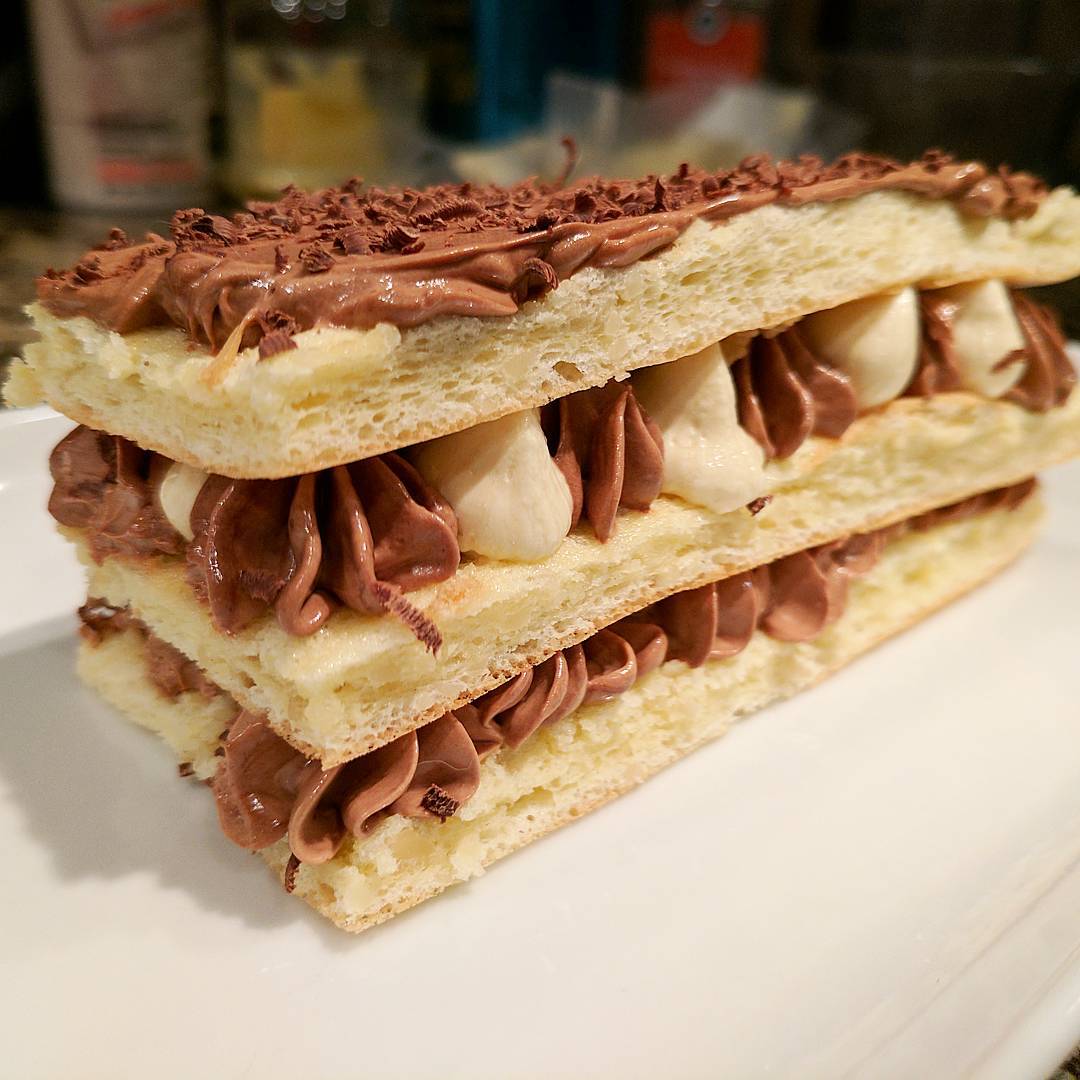
Opera Cake with Coffee and Chocolate Buttercream
May 26, 2017
“Opera cake with coffee and chocolate buttercream.”
A slice of opera cake on a white plate: thin layers of almond sponge alternating with piped coffee buttercream and chocolate buttercream, finished with chocolate shavings.
The gâteau Opéra is a Paris classic, popularized by the house of Dalloyau in the 1950s and named for the Paris Opéra. Tradition calls for thin sheets of joconde, an almond sponge, soaked in coffee syrup and layered with coffee buttercream and chocolate ganache under a chocolate glaze, the whole cake no more than about an inch tall. My version pipes the creams in visible rows, a more rustic take that shows off each layer.
This article is written in Corey’s voice for this tribute site, based on his captions and blog. His own words are the quotes above.
Gâteau Opéra
The opéra is a low, precise Parisian cake of almond joconde sponge soaked in coffee syrup, layered with coffee buttercream and chocolate ganache and sealed with a thin chocolate glaze. Its modern form is credited to Cyriaque Gavillon of the Paris house Dalloyau in 1955, and his wife Andrée is said to have named it for the Opéra Garnier. Gaston Lenôtre made his own celebrated version in the 1960s, and the two houses have long shared the fame.
Ingredients
Joconde sponge
- 225 g almond flour (2 1/4 cups)
- 225 g powdered sugar (scant 2 cups)
- 6 large eggs (300 g), at room temperature
- 60 g all-purpose flour (1/2 cup)
- 180 g egg whites (6 large)
- 30 g granulated sugar (2 1/2 Tbsp)
- 45 g unsalted butter, melted and cooled (3 Tbsp)
Coffee syrup
- 200 g water (3/4 cup plus 1 Tbsp)
- 100 g granulated sugar (1/2 cup)
- 15 g instant espresso powder (2 1/2 Tbsp)
Coffee French buttercream
- 80 g egg yolks (4 large)
- 130 g granulated sugar (2/3 cup)
- 40 g water (2 Tbsp plus 2 tsp)
- 250 g unsalted butter, at 18-20°C / 65-68°F, cubed (1 cup plus 2 Tbsp)
- 10 g instant espresso powder dissolved in 10 g hot water (1 1/2 Tbsp powder, 2 tsp water)
Chocolate ganache
- 160 g dark chocolate, 64 to 70% cacao, chopped
- 130 g heavy cream (1/2 cup plus 1 Tbsp)
- 30 g unsalted butter, softened (2 Tbsp)
Base coat and glaze
- 50 g dark chocolate, melted, for the base coat
- 150 g dark chocolate, 64 to 70% cacao, chopped, for the glaze
- 20 g neutral oil such as grapeseed (1 1/2 Tbsp)
Method
- Heat the oven to 425°F (220°C) and line two 13 x 18-inch (33 x 46 cm) half sheet pans with parchment. Beat the almond flour, powdered sugar and whole eggs on high for 5 minutes until pale and doubled, then fold in the flour.
- Whip the whites to soft peaks, add the granulated sugar and whip to a firm, glossy meringue. Fold a third into the almond batter with the melted butter, then fold in the rest. Divide between the pans, spread evenly, and bake 5-7 minutes until lightly golden and just springy. Slide onto racks and cool.
- Boil the water and sugar for the syrup, remove from the heat and stir in the espresso powder. Cool.
- For the buttercream, start the yolks whipping. Boil the sugar and water to 118°C (244°F), pour down the side of the bowl with the mixer running, and whip until thick, pale and cooled to room temperature. Add the butter a few cubes at a time, then the dissolved espresso, and beat until silky.
- For the ganache, pour the simmering cream over the chocolate, stir until smooth, and blend in the butter once it has cooled to about 40°C (104°F). Leave until thick enough to spread.
- Cut one 10-inch (25 cm) square and one 10 x 5-inch (25 x 12.5 cm) rectangle from each sponge sheet. Spread the 50 g melted chocolate over the skin side of one square and chill until set, then turn it chocolate side down on a parchment-lined board.
- Soak the first layer well with syrup and spread on half the buttercream in an even layer. Lay the two rectangles side by side as the second layer, soak, and spread with all the ganache. Add the last square, soak, and cover with the remaining buttercream, smoothed dead flat. Chill at least 2 hours or freeze 45 minutes until firm.
- Melt the glaze chocolate with the oil, cool to 35-38°C (95-100°F), pour over the cold cake and sweep it level in one or two passes with a long offset spatula. Refrigerate until set, at least 1 hour.
- Trim all four sides with a long knife dipped in hot water and wiped dry to reveal the layers, then cut into bars about 4 x 1 1/4 inches (10 x 3 cm). Serve at cool room temperature so the buttercream is soft.
Chef’s notes
- The finished cake should be no more than about 1 1/4 inches (3 cm) tall with every layer the same thickness. Weigh the buttercream halves and use a ruler: the opéra is judged on its geometry.
- Be generous with the syrup. An opéra with dry sponge tastes of nothing but butter, and each layer should be visibly moist right through.
- If the buttercream curdles, the butter was too cold. Warm the side of the bowl for a few seconds and keep beating. If it turns soupy, chill it 10 minutes and beat again.
- Glaze poured too warm melts the buttercream and streaks. Pour at 35-38°C (95-100°F) onto a cake that is thoroughly cold, and do not go back over it once it starts to set.
Drawn from the methods of
- Dalloyau, Paris (the house credited with the opéra, 1955)
- Dorie Greenspan, Paris Sweets (2002)
- Gaston Lenôtre, Lenôtre's Desserts and Pastries (1977)
- Ferrandi Paris, French Pâtisserie (2017)
Corey has not published his own formula for this piece. This reference recipe is compiled from the published methods of the chefs and bakers listed above, written in our own words.