Lemon Bars!
April 13, 2017
“Lemon bars!”
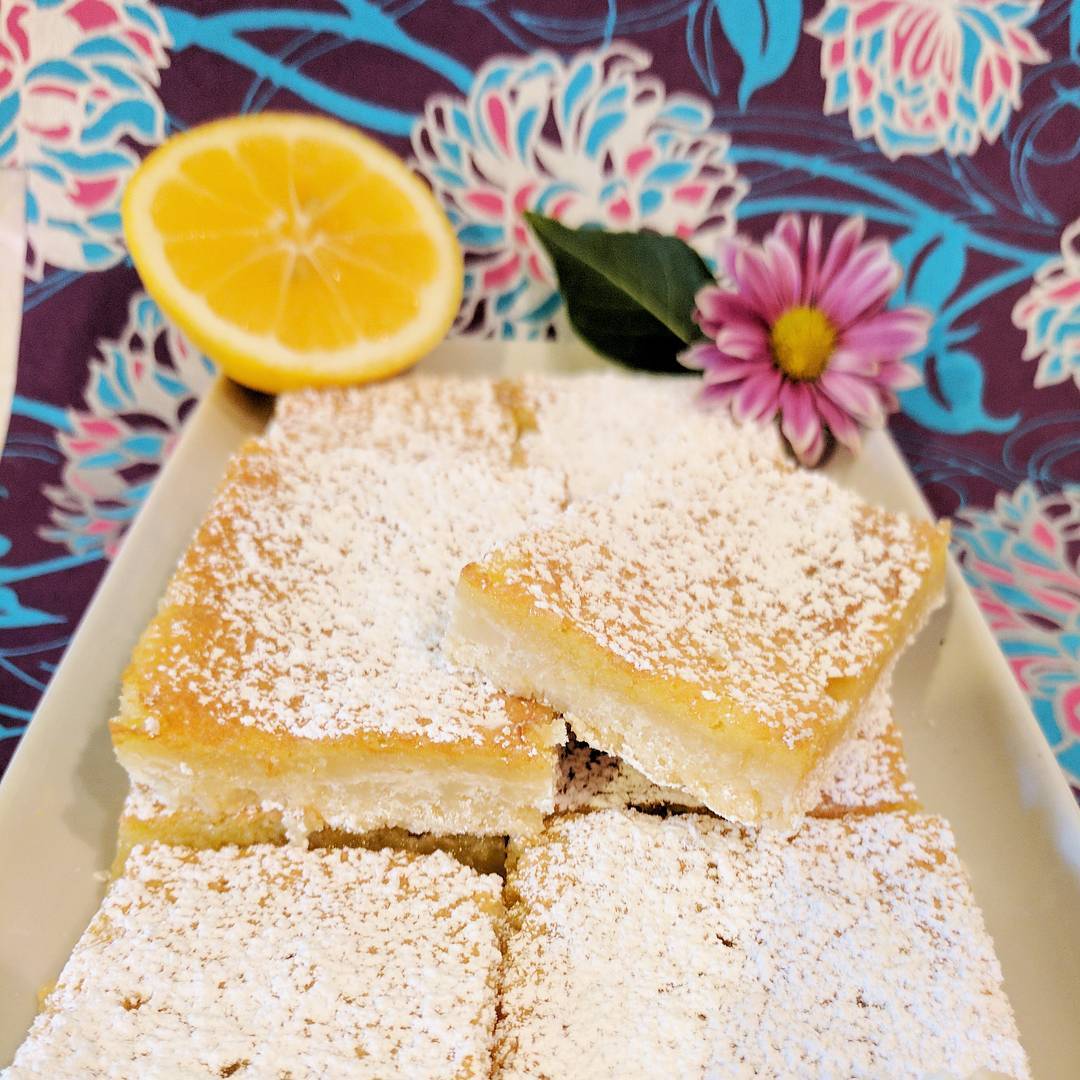
These are my thick lemon bars under a snowfall of powdered sugar, arranged on a tray against a bright floral cloth with a cut lemon and a pink flower.
The lemon bar is an American classic: a shortbread base baked first, then topped with a lemon custard and baked again until just set. The best ones have a filling that is sharp, not just sweet, and a base sturdy enough to pick up. I dust them with powdered sugar right before serving, since the sugar melts into the moist surface. With my Meyer lemon tree in season, these were a certainty.
This article is written in Corey’s voice for this tribute site, based on his captions and blog. His own words are the quotes above.
Lemon Bars
Lemon bars are an American bake-sale classic: a buttery shortbread base under a sharp, soft-set lemon custard, dusted with powdered sugar. Recipes have circulated in American community cookbooks and newspapers since the 1960s. The filling here has a high ratio of juice to sugar so the bars taste distinctly of lemon.
Ingredients
Shortbread crust
- 250 g all-purpose flour (2 cups)
- 75 g powdered sugar (2/3 cup)
- 3 g fine salt (1/2 tsp)
- 225 g cold unsalted butter, cubed (1 cup)
Lemon filling
- 400 g granulated sugar (2 cups)
- Finely grated zest of 3 lemons
- 45 g all-purpose flour (1/3 cup)
- Pinch of fine salt
- 300 g eggs (6 large)
- 240 g fresh lemon juice (1 cup, from 5-6 lemons)
Finish
- Powdered sugar for dusting
Method
- Heat the oven to 350°F (175°C). Line a 9 x 13 inch (23 x 33 cm) metal pan with parchment, leaving an overhang on the long sides.
- Pulse or rub the flour, powdered sugar, salt and butter together until the mixture forms damp, sandy clumps. Press it evenly and firmly into the pan.
- Bake 20-25 minutes until the crust is light golden at the edges and set in the middle.
- While the crust bakes, rub the sugar and zest together until fragrant. Whisk in the flour and salt, then the eggs, then the lemon juice, stirring gently to avoid foam.
- Lower the oven to 325°F (165°C). Pour the filling over the hot crust as soon as it comes out, so the crust seals.
- Bake 20-25 minutes, until the filling is set at the edges and jiggles only slightly in the centre when the pan is nudged.
- Cool completely on a rack, then chill at least 2 hours until firm.
- Lift out by the parchment, cut into bars with a hot, clean knife, and dust with powdered sugar just before serving.
Chef’s notes
- Pouring the filling onto a cooled crust lets it seep underneath. The crust must be hot from the oven.
- A foamy white layer on top comes from whisking in too much air. Stir gently, and skim the foam before baking if needed.
- Overbaked filling turns rubbery and cracks. Take the pan out while the centre still has a slight tremble.
- Powdered sugar dissolves on the moist surface within an hour, so dust at the last moment.
Drawn from the methods of
- King Arthur Baking Company
- Dorie Greenspan, Baking: From My Home to Yours (2006)
- Stella Parks, BraveTart (2017)
Corey has not published his own formula for this piece. This reference recipe is compiled from the published methods of the chefs and bakers listed above, written in our own words.