Hot Chocolate Wafer Cookie
April 16, 2017
“Hot Chocolate Wafer Cookie”
I perched a thin, dark, crackled chocolate wafer on the rim of a coupe glass like a citrus wheel, with a pink drink below it. #happyhour.
This one is a styled shot, lit like a cocktail ad, and it shows the photography side of my 2017 project. The cookie is a chocolate wafer, the thin, crisp, intensely cocoa kind you use for icebox cakes and cookie crusts. The dark color comes from Dutch-process cocoa, which is treated to reduce its acidity and deepens almost to black. I cut a slot while the cookie was still warm from the oven so that it could sit on the glass.
This article is written in Corey’s voice for this tribute site, based on his captions and blog. His own words are the quotes above.
Thin Crisp Wafer Cookies
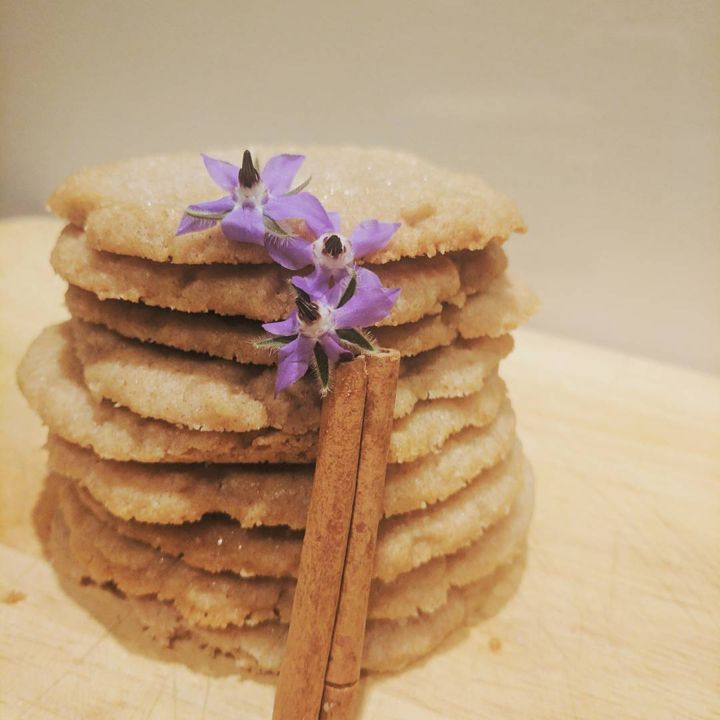
In American baking a wafer is a very thin, snappy slice-and-bake cookie, the style made familiar by the packaged chocolate wafers that appeared in the 1920s and became the basis of the icebox cake. This is one butter dough with two finishes: a cinnamon sugar wafer and a dark, bittersweet version that tastes like a cup of hot chocolate.
Ingredients
Wafer dough
- 115 g unsalted butter, softened (1/2 cup)
- 130 g granulated sugar (2/3 cup)
- 2 g fine sea salt (rounded 1/4 teaspoon)
- 1 large egg (about 50 g without shell)
- 5 g pure vanilla extract (1 teaspoon)
- 190 g all-purpose flour (1 1/2 cups)
- 1/4 teaspoon baking soda
Cinnamon sugar variation
- 50 g granulated sugar (1/4 cup)
- 5 g ground cinnamon (2 teaspoons)
Hot chocolate variation
- Reduce the flour to 150 g (1 cup plus 3 tablespoons)
- 40 g Dutch-process cocoa powder (scant 1/2 cup), sifted
- 60 g dark chocolate, 70 percent cacao, grated or very finely chopped (2 ounces)
- 15 g whole milk (1 tablespoon)
- Pinch of ground cinnamon (optional)
Method
- Beat the butter, sugar and salt until smooth and creamy, about 2 minutes. Beat in the egg and vanilla.
- Whisk the flour with the baking soda and mix it in on low speed just until a soft dough forms. For the hot chocolate version, whisk the cocoa and cinnamon into the reduced amount of flour, add the milk with the egg, and fold in the grated chocolate at the end.
- Divide the dough in two and shape each half on parchment into a log about 4 cm (1 1/2 inches) in diameter. Roll the parchment tightly around the log to make it round and even.
- For the cinnamon sugar version, mix the sugar and cinnamon, spread it on the counter and roll the logs in it to coat, pressing so it sticks. Keep the leftover mixture.
- Refrigerate the logs for at least 2 hours, or freeze for 45 minutes, until very firm. A firm log is the only way to cut slices this thin.
- Heat the oven to 350°F (175°C) and line baking sheets with parchment. Slice the logs 3 mm (1/8 inch) thick with a thin sharp knife and space the slices 4 cm (1 1/2 inches) apart. Sprinkle the cinnamon wafers with a little more of the cinnamon sugar.
- Bake for 10 to 12 minutes, turning the sheets halfway. Plain and cinnamon wafers are done when golden brown at the edges; chocolate wafers are done when they have puffed, then settled, and smell strongly of cocoa.
- Cool completely on the sheets. The wafers are soft when hot and turn crisp as they cool.
Chef’s notes
- If the cooled wafers bend instead of snap, they were cut too thick or underbaked. Return them to a 300°F (150°C) oven for 5 minutes and cool again.
- Cocoa dough gives no color cue, so bake a test tray of three or four wafers first and time the rest from that.
- A log with a flat side comes from resting on the shelf while soft. Turn it a quarter turn every 15 minutes for the first half hour of chilling, or rest it in a cardboard paper towel tube slit lengthwise.
- Store airtight as soon as they are cool. Thin wafers pick up moisture from the air within hours and lose their snap.
Drawn from the methods of
- Alice Medrich, Pure Dessert (2007)
- Maida Heatter, Maida Heatter's Book of Great Cookies (1977)
- Stella Parks, BraveTart (2017)
Corey has not published his own formula for this piece. This reference recipe is compiled from the published methods of the chefs and bakers listed above, written in our own words.