Baked Alaska, an Oldie but a Goodie
September 18, 2017
“Baked Alaska, an oldie but a goodie!”
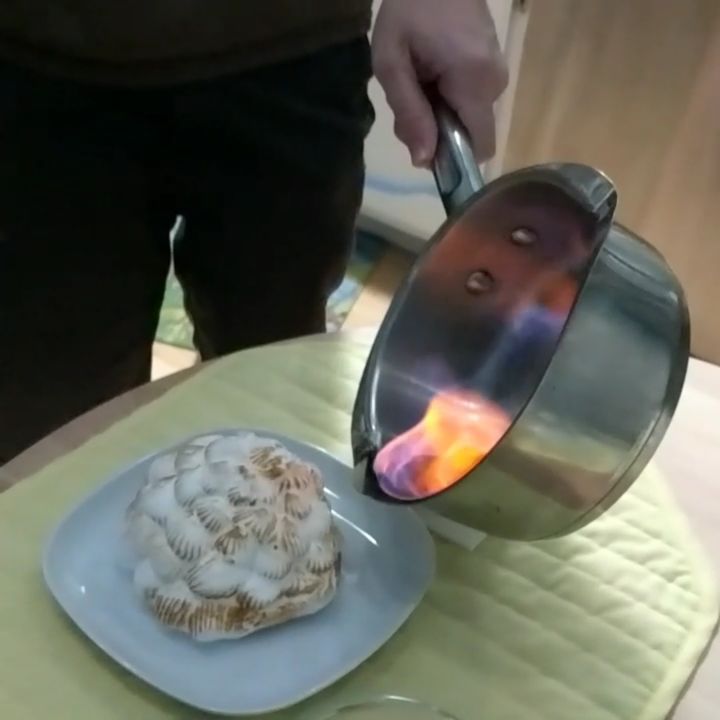
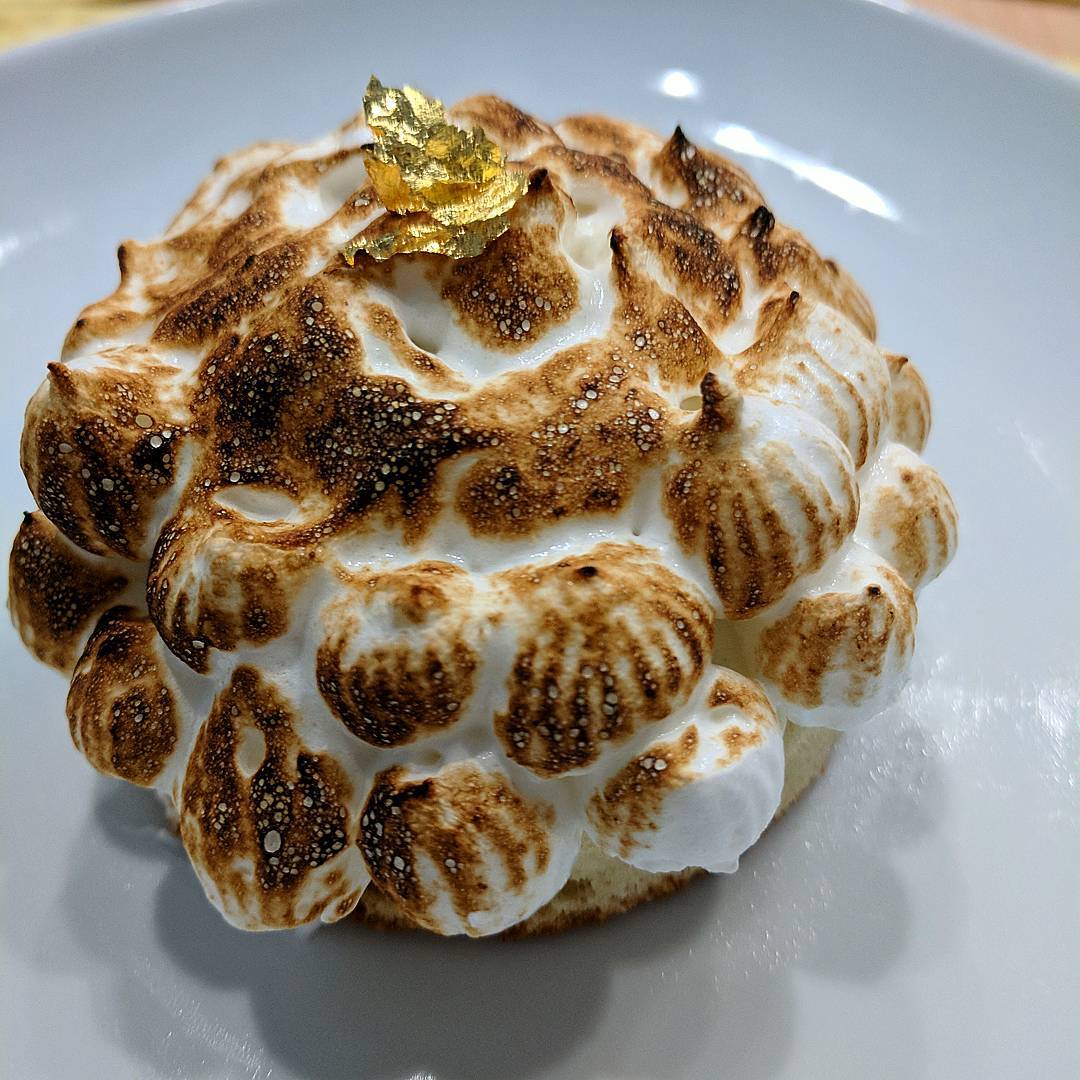
An oldie but a goodie, in two photos: a dome of meringue piped in shells and torched until the tips are nearly black, with gold leaf on top, and then the cut, showing a thick layer of ice cream over a sponge base, sealed inside the meringue.
Baked Alaska is a nineteenth-century showpiece, generally credited to Delmonico's in New York, where it was named in honor of the American purchase of Alaska in 1867. The trick it plays, hot outside and frozen inside, depends on meringue being full of air and so a poor conductor of heat. The ice cream must be frozen very hard and the meringue must seal it completely, right down to the plate. I made this one gluten-free.
This article is written in Corey’s voice for this tribute site, based on his captions and blog. His own words are the quotes above.
Baked Alaska
Baked Alaska hides ice cream on a sponge base under a thick coat of meringue, which is browned quickly while the centre stays frozen. The air in the meringue and sponge insulates the ice cream from the heat. The dish is closely associated with Delmonico's in New York, whose chef Charles Ranhofer published it as Alaska, Florida in his 1894 book The Epicurean.
Ingredients
Sponge base (génoise)
- 150 g eggs (3 large)
- 90 g granulated sugar (7 tbsp)
- 90 g all-purpose or cake flour, sifted (3/4 cup)
- 25 g unsalted butter, melted and warm (2 tbsp)
- 4 g vanilla extract (1 tsp)
- Pinch of fine salt
Ice cream centre
- 1.4 litres ice cream or sorbet, one flavour or two or three layered (1 1/2 quarts)
Swiss meringue
- 180 g egg whites (6 large)
- 360 g granulated sugar (1 3/4 cups plus 1 tbsp)
- 1 g cream of tartar (1/4 tsp)
- 4 g vanilla extract (1 tsp)
Flambé (optional)
- 60 g dark rum, brandy or kirsch at 40% ABV or higher (1/4 cup)
Method
- Line a 2-litre (2 quart) bowl about 20 cm (8 inches) across with plastic wrap, leaving a generous overhang. Soften the ice cream slightly and pack it in, layering flavours if you like and pressing out air pockets. Cover and freeze until rock hard, at least 4 hours.
- Heat the oven to 350°F (175°C). Grease and line an 8-inch (20 cm) round cake pan.
- Whisk the eggs, sugar and salt over simmering water until warm to the touch, about 110°F (43°C), then whip on high speed for 6-8 minutes until tripled, pale and holding a thick ribbon.
- Fold in the flour in three additions, then fold a scoop of batter into the warm butter and vanilla and fold that back in. Bake 20-25 minutes until golden and springy, then cool completely.
- Trim the sponge level if needed and set it on an ovenproof platter or a parchment-lined board. Unmould the ice cream dome onto the sponge, peel off the plastic, and return it to the freezer.
- Make the meringue by whisking the whites, sugar and cream of tartar over simmering water to 160°F (71°C), until the sugar is fully dissolved. Whip on high 6-8 minutes until stiff, glossy and barely warm, adding the vanilla at the end.
- Working quickly, cover the dome and the sides of the sponge with meringue at least 2.5 cm (1 inch) thick, sealing it right down to the platter. Swirl into peaks or pipe it. The covered dessert can be frozen for up to a day at this point.
- Brown the meringue all over with a blowtorch, or bake at 500°F (260°C) for 3-4 minutes until the peaks are golden.
- To flambé, warm the spirit gently in a small pan until just steaming, never boiling. Away from anything flammable, ignite it with a long match, pour it flaming over the dessert at the table, and let the flames die before slicing with a hot knife.
Chef’s notes
- Any gap in the meringue lets heat reach the ice cream. Seal it completely to the plate and keep the coat thick.
- The ice cream must be frozen hard before the meringue goes on. If it softens while you work, freeze the whole thing again for 30 minutes before browning.
- For a gluten-free base, replace the flour with 60 g almond flour and 30 g cornstarch, or use a flourless chocolate sponge or a gluten-free brownie layer. The rest of the dessert is naturally gluten-free.
- Cold spirit will not light, and boiled spirit has lost its alcohol. Warm it only until wisps of steam appear, and never pour from the bottle near a flame.
Drawn from the methods of
- Charles Ranhofer, The Epicurean (1894)
- Bo Friberg, The Professional Pastry Chef (2002)
- Rose Levy Beranbaum, The Cake Bible (1988)
- Stella Parks, BraveTart (2017)
Corey has not published his own formula for this piece. This reference recipe is compiled from the published methods of the chefs and bakers listed above, written in our own words.