"I Had to Make a Lot of Crème Brûlée Yesterday!"
June 24, 2017
“I had to make a lot of creme brulee yesterday!”
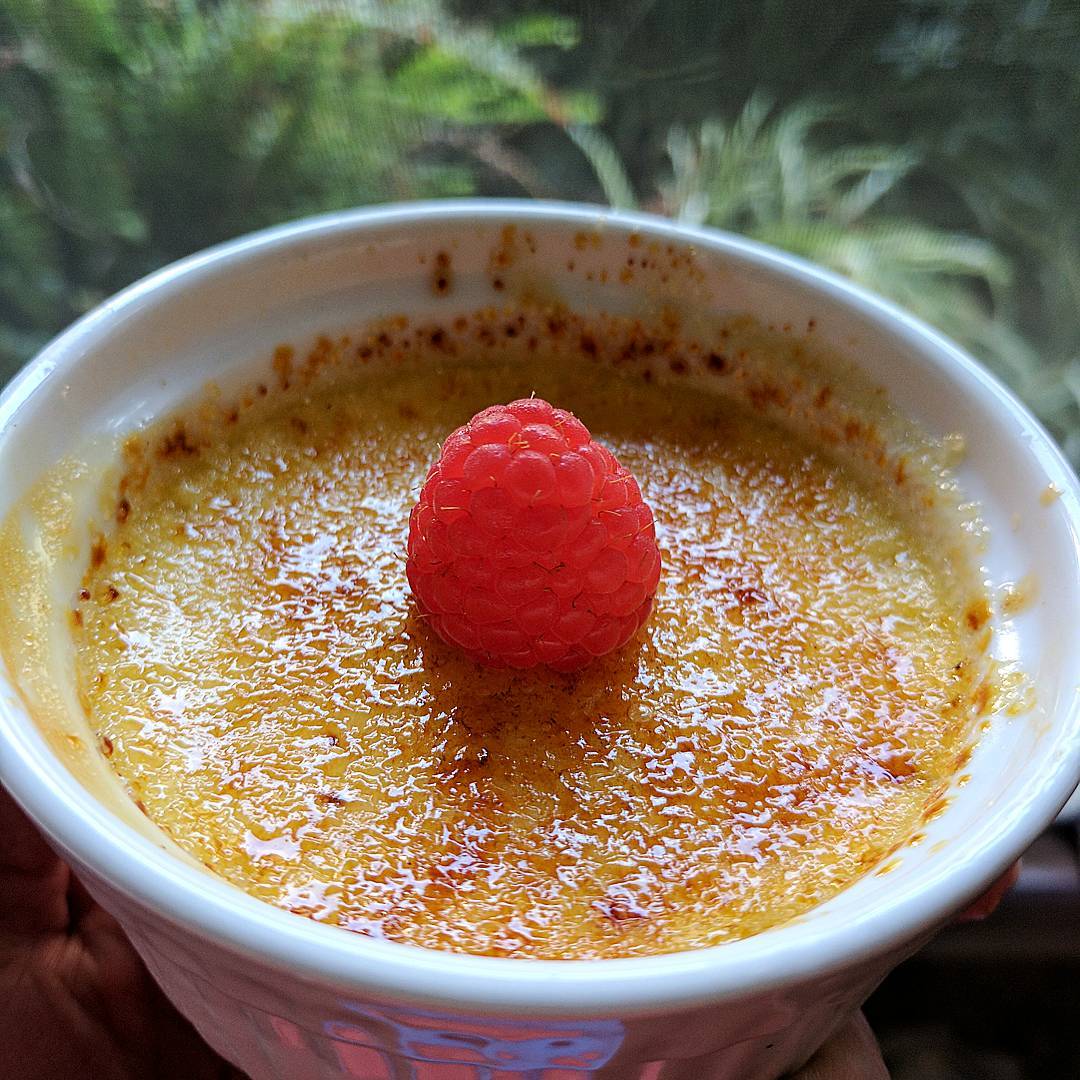
I had to make a lot of crème brûlée yesterday! Here is one: a fluted white ramekin with a mottled amber sugar crust and a single raspberry in the center.
Crème brûlée is three ingredients, cream, egg yolks and sugar, plus vanilla, and it is all technique. The custard is baked in a water bath at a low temperature until it's just set and still trembles. Just before serving, a thin layer of sugar is melted and caramelized into a glassy sheet. The contrast between the cold, silky custard and the warm, brittle caramel is the whole point, so the top is never torched ahead of time.
This article is written in Corey’s voice for this tribute site, based on his captions and blog. His own words are the quotes above.
Crème Brûlée
Crème brûlée is a baked custard of cream, egg yolks, sugar and vanilla under a thin sheet of caramelised sugar that shatters at the tap of a spoon. A recipe under this name appears in François Massialot's French cookbook of 1691, and England's Trinity College, Cambridge has long served a similar burnt cream. It became a restaurant signature around the world in the 1980s.
Ingredients
Custard
- 500 g heavy cream, 35-40% fat (2 cups plus 2 tbsp)
- 1 vanilla bean, split and scraped
- 100 g egg yolks (5 large)
- 70 g granulated sugar (1/3 cup)
- Pinch of fine salt
Caramel top
- 50 g granulated or superfine sugar (about 2 tsp per ramekin)
Method
- Heat the oven to 300°F (150°C). Set six shallow ramekins in a deep roasting pan and put a kettle of water on to boil.
- Bring the cream, vanilla seeds and pod just to a simmer. Remove from the heat, cover and infuse for 15 minutes.
- Whisk the yolks, sugar and salt just until combined, without whipping in air. Slowly stir in the warm cream.
- Strain the custard into a jug, skim off any foam, and divide among the ramekins.
- Pour hot water into the roasting pan to come halfway up the sides of the ramekins. Bake 30-40 minutes, until the custards are set at the edge and tremble like jelly in the centre, about 170-175°F (77-80°C) inside.
- Lift the ramekins out of the water, cool to room temperature, then chill uncovered for at least 4 hours or overnight.
- Blot any moisture from the surface. Sprinkle each custard with an even, thin layer of sugar, tilting and tapping to cover, and tip out the excess.
- Caramelise with a blowtorch held 5-8 cm (2-3 inches) away, moving constantly, until the sugar melts and turns deep amber. Let the crust harden for 2 minutes and serve within 30 minutes.
Chef’s notes
- A grainy or weeping custard was overbaked. Pull the ramekins while the centres still wobble, as they finish setting as they cool.
- Bubbles on the surface come from whisking too hard. Stir gently and skim the foam before baking.
- The crust softens as it draws moisture from the custard, so torch just before serving and never refrigerate after torching.
- Two thin layers of sugar, torched one after the other, give a thicker and more even crust than one heavy layer.
Torch or broiler for the sugar crust?
Blowtorch
Thomas Keller, Dominique Ansel and most restaurant pastry kitchens
A torch melts and browns the sugar in under a minute while the custard beneath stays cold. It gives precise control and the sharpest contrast between warm, brittle caramel and chilled cream. This recipe uses this method.
Broiler or salamander
Julia Child, Jacques Pépin and traditional French kitchens, which historically used a red-hot iron
The sugared custards are set in a pan of ice and placed as close as possible under a very hot broiler for 1-3 minutes. No special tool is needed and the colour is even, but the custard warms and can loosen if left a moment too long.
Drawn from the methods of
- Julia Child, Louisette Bertholle and Simone Beck, Mastering the Art of French Cooking (1961)
- Thomas Keller, Bouchon (2004)
- Bo Friberg, The Professional Pastry Chef (2002)
Corey has not published his own formula for this piece. This reference recipe is compiled from the published methods of the chefs and bakers listed above, written in our own words.