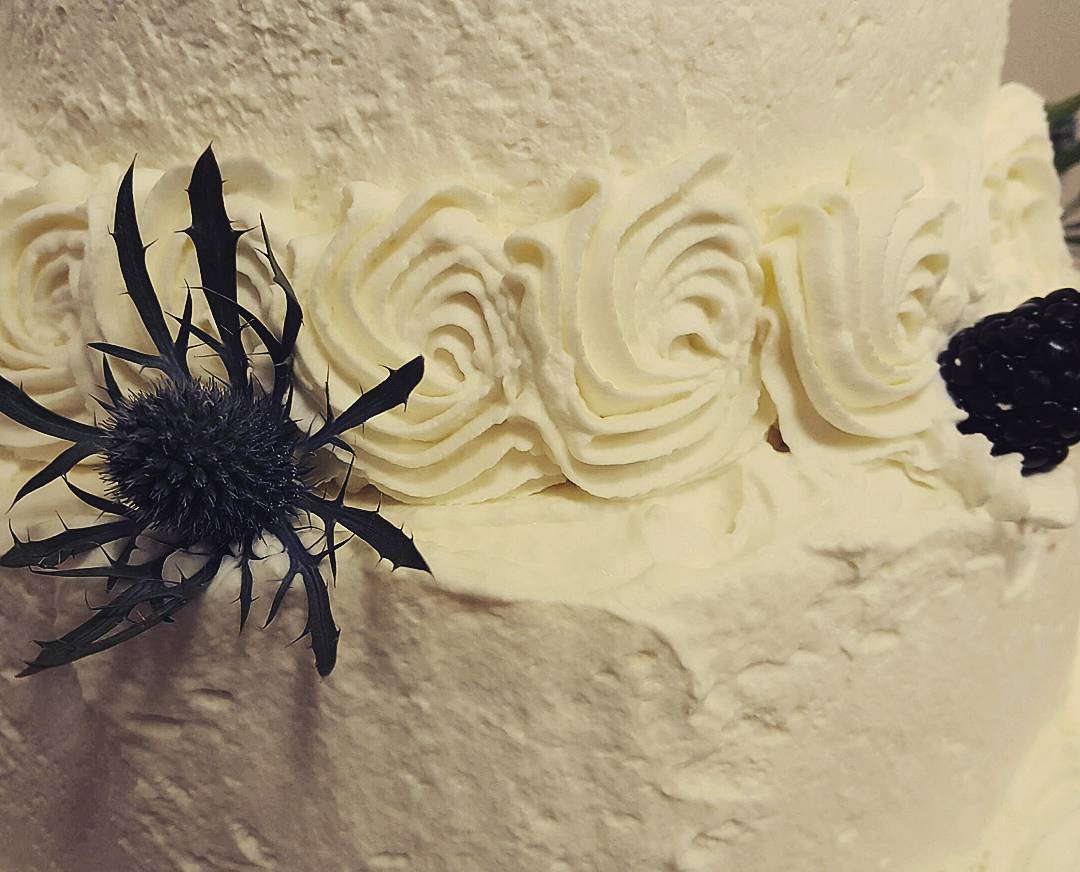
Rosettes for a Wedding Cake
March 25, 2017
“A fbf of rosettes for a wedding cake last year”
This is a close-up of the side of a white wedding cake: a row of deep, swirled buttercream rosettes along a tier, with a spiky blue thistle tucked against them.
I posted it in March 2017 as a flashback to a wedding cake from the year before, which makes it some of my earliest work in the collection, from before the blog began. You pipe a rosette with an open star tip, starting in the center and spiraling outward in one continuous motion. A row of them is only as good as its consistency. The rough-textured finish on the cake above and the blue thistle give it a rustic, garden-wedding look.
This article is written in Corey’s voice for this tribute site, based on his captions and blog. His own words are the quotes above.
Swiss Meringue Buttercream
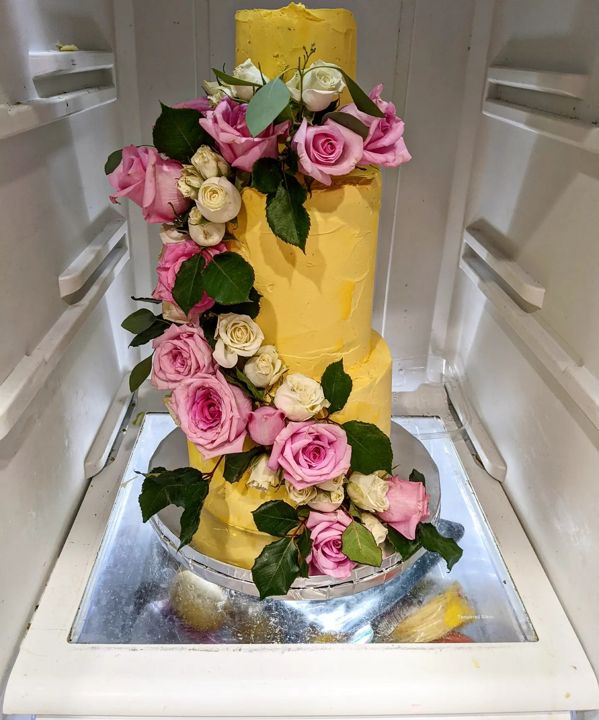
Swiss meringue buttercream is made by warming egg whites and sugar together over hot water, whipping them into a stable meringue and beating in soft butter. It is far less sweet than American powdered sugar frosting, smooth enough for sharp edges and firm enough to pipe, which has made it the standard finish for wedding and celebration cakes. This recipe also covers piping rosettes and stacking a tiered cake with fresh flowers.
Ingredients
Buttercream
- 150 g egg whites (5 large)
- 250 g granulated sugar (1 1/4 cups)
- 1/4 tsp fine salt
- 1/4 tsp cream of tartar (optional)
- 450 g unsalted butter, cut into pieces, at 18-20°C / 65-68°F (2 cups, 4 sticks)
- 2 tsp vanilla extract or the seeds of 1 vanilla bean
For rosettes and stacking
- Piping bag with a large open star tip (Wilton 1M) or closed star tip (Wilton 2D)
- Cardboard cake round under every tier, the same diameter as the tier
- Wooden or plastic dowels, or wide bubble tea straws: 5 for a 6-inch tier above, 7 for an 8-inch tier above
- Food-safe flower picks or drinking straws, and floral tape
- Unsprayed edible flowers such as roses, pansies, violas, nasturtiums or chamomile
Method
- Wipe the mixer bowl and whisk with a little vinegar or lemon juice to remove any grease. Combine the whites, sugar, salt and cream of tartar in the bowl and set it over a pan of gently simmering water without letting the bowl touch the water.
- Whisk constantly until the sugar has fully dissolved and the mixture reaches 71°C (160°F). Rub a little between your fingers: it should feel completely smooth, with no grit.
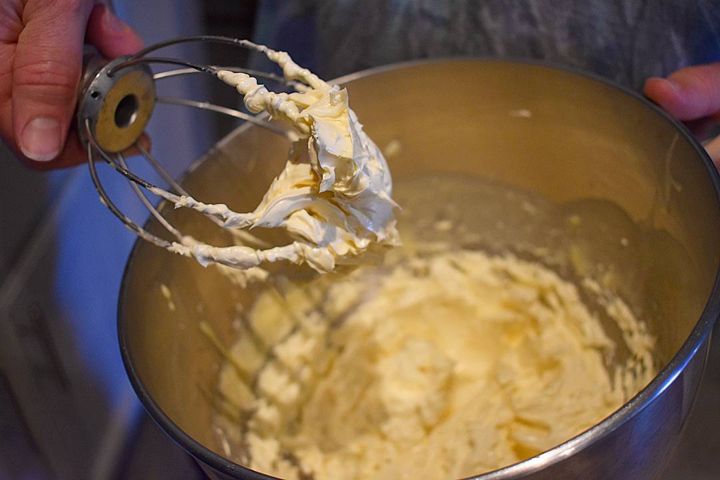
- Move the bowl to the mixer and whip on high until the meringue is thick, glossy and stiff and the outside of the bowl feels neutral to the touch, about 10 minutes. The meringue should be below 30°C (86°F) before any butter goes in.
- Switch to the paddle. On medium-low speed add the butter a piece at a time, waiting for each to disappear. The mixture may look curdled or soupy partway through: keep beating and it will come together.
- Add the vanilla and beat on the lowest speed for 3-5 minutes to press out air bubbles and leave the buttercream dense and silky.
- To pipe rosettes, fit a bag with the star tip and hold it straight up, about 1/2 inch (1 cm) above the surface. Start in the center, squeeze with steady pressure, and spiral outward for one and a half turns, then release pressure and trail off along the edge so the tail tucks under the next rosette.
- To stack tiers, chill each frosted tier on its own cardboard round until firm, at least 1 hour. Push one dowel straight down into the lower tier, mark it level with the frosting, pull it out and cut all the dowels for that tier to exactly the same length.
- Insert the dowels in a circle about 1 inch (2.5 cm) inside the footprint of the tier above, with one in the center. Spread a little buttercream on top as glue, lower the next tier into place with a wide spatula, and pipe a border to cover the seam. For transport, drive one long sharpened dowel down through all tiers and boards.
- For fresh flowers, use only blooms known to be nontoxic and grown without pesticides, never florist or roadside flowers of unknown origin. Avoid toxic plants entirely, including lily of the valley, hydrangea, foxglove, oleander, delphinium, daffodil and sweet pea.
- Never push a bare stem into cake. Trim stems short, wrap them in floral tape and seat them in flower picks or straws, or rest blooms on a small disc of parchment, and add them as close to serving as possible.
Chef’s notes
- Soupy buttercream means the meringue or butter was too warm. Refrigerate the whole bowl for 15-20 minutes and beat again. It will tighten up.
- Curdled, cottage cheese texture means the butter was too cold. Warm the side of the bowl briefly with a hot towel or a hair dryer, or melt a few spoonfuls and beat them back in.
- If it tastes like plain butter, add another pinch of salt and more vanilla, and make sure the meringue was whipped fully stiff before the butter went in.
- Buttercream keeps 1 week refrigerated or 3 months frozen. Bring it all the way back to room temperature, then beat with the paddle for several minutes before using. Cold buttercream that is beaten too early will split.
Swiss or Italian meringue buttercream?
Swiss meringue
Stella Parks, Claire Saffitz and most contemporary cake designers
Whites and sugar are heated together over water and then whipped, with no syrup to boil or pour. It is simpler, easier to repeat without special skill, and gives a dense, satiny buttercream that smooths and pipes beautifully. This recipe follows this method.
Italian meringue
Rose Levy Beranbaum, Thomas Keller and Sebastien Rouxel, and the classical French school
A sugar syrup cooked to about 118-120°C (244-248°F) is poured onto whipping whites, cooking them into the most stable of all meringues. The buttercream is slightly lighter and holds best in warm rooms, at the price of handling boiling syrup and exact timing.
Drawn from the methods of
- Stella Parks, BraveTart (2017)
- Rose Levy Beranbaum, The Cake Bible (1988)
- Thomas Keller and Sebastien Rouxel, Bouchon Bakery (2012)
- Claire Saffitz, Dessert Person (2020)
Corey has not published his own formula for this piece. This reference recipe is compiled from the published methods of the chefs and bakers listed above, written in our own words.