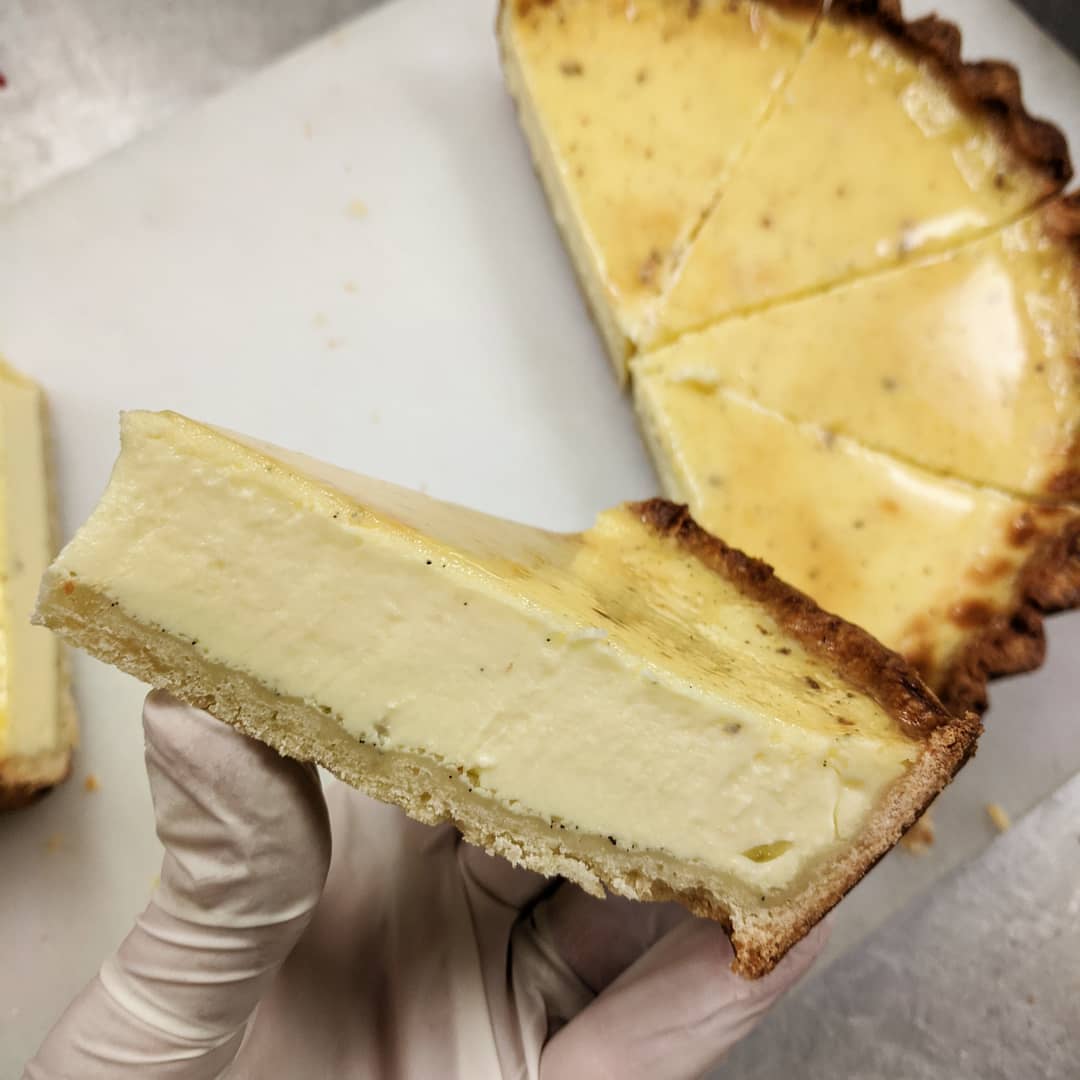
Vanilla Bean Custard Tart
March 7, 2020
“Every now and again I manage to make something really good. Like this”
Every now and again I manage to make something really good. This is a wedge of custard tart held up to show its profile: a deep, pale, perfectly set filling speckled with vanilla seeds, a lightly browned top, and a crisp shell.
A baked custard tart has nowhere to hide. Overbake it and the custard curdles and cracks, underbake it and it won't slice. The clean, straight cut face here, with no weeping and no gap between the filling and the crust, means the custard was cooked just to the set point and cooled fully before cutting. The French version, flan pâtissier, has been taken up by Paris's leading pastry chefs in recent years as a test of pure technique.
This article is written in Corey’s voice for this tribute site, based on his captions and blog. His own words are the quotes above.
Vanilla Custard Tart (Flan Pâtissier)
Flan pâtissier, also called flan parisien, is the tall baked custard tart sold by the slice in bakeries all over France. A thick vanilla pastry cream is poured into a pastry shell and baked at high heat until the top blisters dark brown, then chilled until it slices cleanly. In recent years Paris pastry chefs have revived it as a showpiece.
Ingredients
Pâte brisée
- 250 g all-purpose flour (2 cups)
- 150 g cold unsalted butter, cubed (10 1/2 tbsp)
- 20 g granulated sugar (1 1/2 tbsp)
- 4 g fine salt (3/4 tsp)
- 20 g egg yolk (1 large)
- 50 g ice water (3 1/2 tbsp)
Vanilla custard
- 750 g whole milk (3 cups plus 2 tbsp)
- 250 g heavy cream (1 cup plus 1 tbsp)
- 2 vanilla beans, split and scraped
- 200 g granulated sugar (1 cup)
- 90 g cornstarch (3/4 cup)
- 100 g eggs (2 large)
- 80 g egg yolks (4 large)
- 50 g unsalted butter, cubed (3 1/2 tbsp)
- Pinch of fine salt
Method
- Make the dough. Rub the butter into the flour, sugar and salt until it resembles coarse crumbs, add the yolk and water, and press together without kneading. Wrap and chill at least 1 hour.
- Roll to 3 mm (1/8 inch) and line a buttered 8-inch (20 cm) ring or springform that is 6 cm (2.4 inches) deep, bringing the dough right to the top. Freeze for at least 30 minutes.
- Heat the milk, cream, vanilla seeds and pods with half the sugar until steaming. Cover and infuse 20 minutes if time allows, then return to a simmer and remove the pods.
- Whisk the remaining sugar with the cornstarch and salt, then whisk in the eggs and yolks until smooth. Pour in the hot milk gradually, whisking.
- Return everything to the pan and cook over medium heat, whisking constantly, until very thick and boiling. Boil for 1 full minute, then whisk in the butter off the heat.
- Press plastic wrap onto the surface and let the custard cool for 20-30 minutes until warm, then whisk it smooth. Heat the oven to 375°F (190°C) with a rack in the lower third.
- Pour the custard into the frozen, unbaked shell and smooth the top. Trim the pastry level with the custard.
- Bake 50-60 minutes, until the pastry is golden and the top is puffed with dark brown blisters. The centre will still wobble.
- Cool to room temperature in the ring, then chill at least 6 hours or overnight before unmoulding and slicing.
Chef’s notes
- Cutting the flan before it is completely cold gives a slumped, creamy slice. It needs a full night in the refrigerator to set.
- If the top is pale after 50 minutes, raise the oven to 425°F (220°C) for the last 5-8 minutes. The dark patches are the signature of the tart.
- Freezing the lined ring is what stops the raw pastry sliding down the tall sides as it bakes.
- A flan that cracks deeply was baked too long or cooled too fast. Take it out while the centre still trembles.
Shortcrust or puff pastry shell?
Pâte brisée (shortcrust)
Traditional French boulangeries, Ferrandi Paris
A plain, lightly sweetened shortcrust is the traditional bakery shell. It is sturdy, easy to line into a deep ring, and its neutral crunch keeps the focus on the custard. This recipe uses this method.
Puff pastry
Many contemporary Paris pastry chefs, who often line the ring with puff pastry or trimmings
Puff pastry, often well-rested trimmings, is rolled thin and lined raw. It bakes into a flaky, deeply caramelised, buttery case that contrasts more strongly with the soft custard, but it takes more skill to keep from shrinking.
Drawn from the methods of
- Ferrandi Paris, French Pâtisserie (2017)
- Christophe Felder, Patisserie: Mastering the Fundamentals of French Pastry (2013)
- Bo Friberg, The Professional Pastry Chef (2002)
Corey has not published his own formula for this piece. This reference recipe is compiled from the published methods of the chefs and bakers listed above, written in our own words.