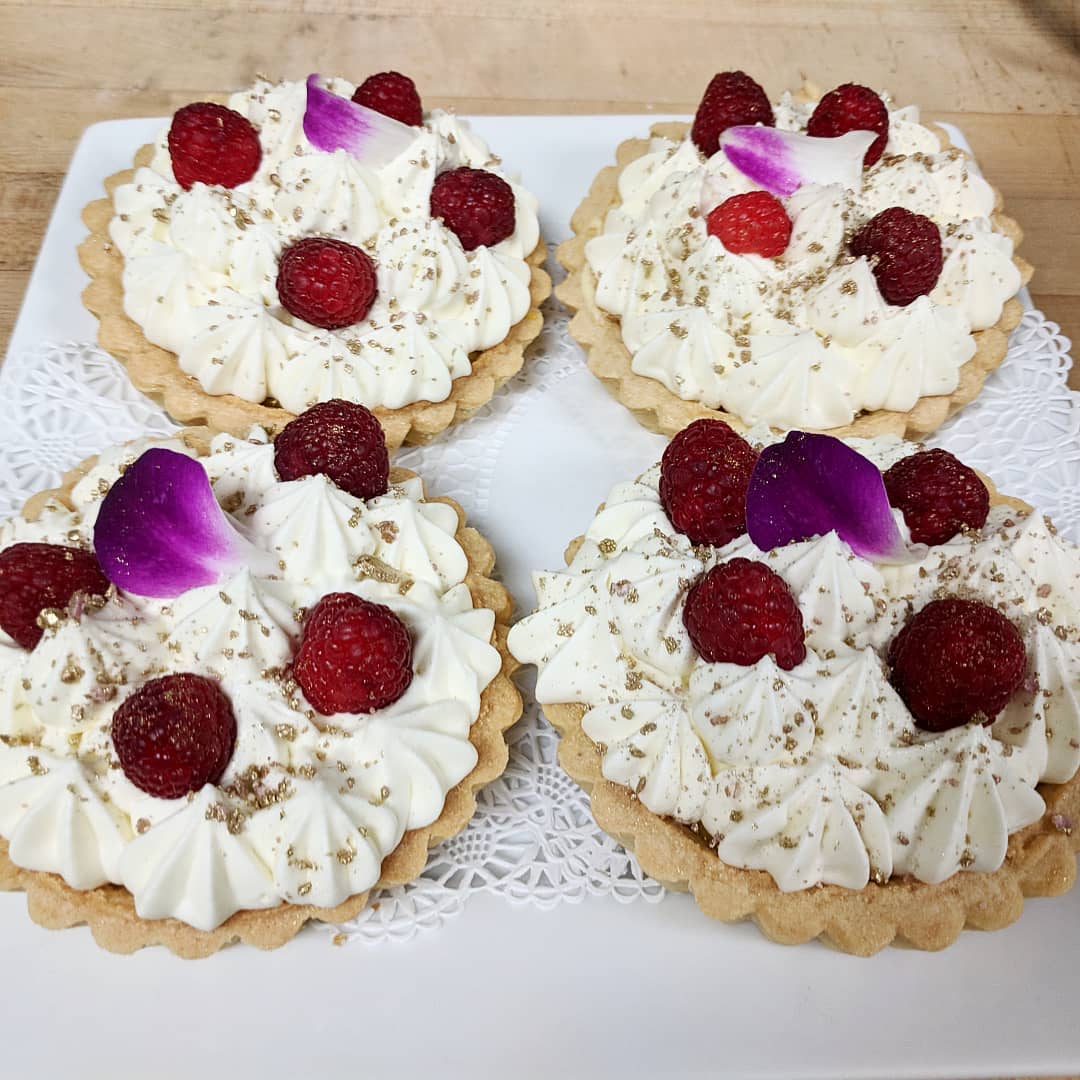
Passion Fruit and White Chocolate Mousse Tarts
May 16, 2018
“Passion fruit curd and white chocolate mousse tart. Pretty happy with how they turned out.”
I'm pretty happy with how these turned out. Four fluted tarts filled with passion fruit curd, covered in piped stars of white chocolate mousse and finished with raspberries, flower petals and a scatter of grated chocolate.
The pairing is a modern classic. Passion fruit is one of the most acidic and aromatic fruits in the pastry kitchen, and white chocolate is the sweetest and mildest of the chocolates, so each fixes the other's weakness. Pierre Hermé made the related pairing of passion fruit and milk chocolate famous with his Mogador. I piped the mousse directly onto the curd, so each forkful carries both.
This article is written in Corey’s voice for this tribute site, based on his captions and blog. His own words are the quotes above.
Passion Fruit and White Chocolate Tart
A contemporary French-style tart that sets the sharp, tropical acidity of passion fruit curd against a soft white chocolate mousse. The sweetness and dairy richness of white chocolate are a well-established foil for passion fruit in modern pâtisserie, and the two layers give a clean contrast of colour and texture when sliced.
Ingredients
Pâte sucrée
- 250 g all-purpose flour (2 cups)
- 30 g almond flour (1/3 cup)
- 95 g powdered sugar (3/4 cup plus 1 tbsp)
- 2 g fine salt (1/3 tsp)
- 150 g unsalted butter, soft but cool (10 1/2 tbsp)
- 50 g egg (1 large)
Passion fruit curd
- 150 g strained passion fruit purée, from about 10 fruit (2/3 cup)
- 120 g granulated sugar (1/2 cup plus 2 tbsp)
- 150 g eggs (3 large)
- 40 g egg yolks (2 large)
- 2 g powdered gelatin (2/3 tsp) bloomed in 10 g cold water, or 1 gelatin sheet
- 150 g unsalted butter, cool room temperature, cubed (10 1/2 tbsp)
White chocolate mousse
- 150 g good white chocolate, finely chopped (5 1/4 oz)
- 70 g heavy cream, for the ganache base (1/3 cup)
- 2 g powdered gelatin (2/3 tsp) bloomed in 10 g cold water, or 1 gelatin sheet
- 200 g heavy cream, very cold, for whipping (3/4 cup plus 2 tbsp)
Finish
- Pulp and seeds of 1 passion fruit
- White chocolate curls or shavings
Method
- Make the dough: beat the butter, powdered sugar and salt until smooth, add the almond flour and egg, then the flour, mixing just until combined. Chill at least 2 hours.
- Roll to 3 mm (1/8 inch), line a 9-inch (23 cm) tart ring and chill 30 minutes. Blind bake at 350°F (175°C) with weights for 15 minutes, then 8-12 minutes without, until golden. Cool.
- For the curd, whisk the purée, sugar, eggs and yolks in a saucepan. Cook over medium-low heat, stirring constantly, until thick and 180°F (82°C).
- Strain into a tall container, stir in the bloomed gelatin and let cool to 140°F (60°C). Blend in the butter a few pieces at a time with a stick blender until smooth and glossy.
- Pour the curd into the shell so it comes about two-thirds of the way up. Chill until firm, at least 2 hours.
- For the mousse, bring the 70 g cream to a simmer, dissolve the bloomed gelatin in it and pour over the white chocolate. Stir until smooth, then let cool to 85°F (30°C).
- Whip the cold cream to soft peaks. Fold one third into the white chocolate base to loosen it, then fold in the rest gently.
- Spread the mousse over the set curd and level it with the rim, or chill the mousse 1 hour and pipe it in rounds. Chill 3 hours until set.
- Finish with a spoonful of fresh passion fruit pulp and white chocolate curls just before serving.
Chef’s notes
- White chocolate seizes and turns grainy if overheated. Let the hot cream do the melting and never put the bowl over direct heat.
- Folding whipped cream into a base that is still warm deflates the mousse. Check that it is around 85°F (30°C), cool but still fluid.
- Frozen unsweetened passion fruit purée is consistent and is what most pastry kitchens use. If yours is sweetened, cut the curd sugar by 15 g.
- Whip the cream only to soft peaks. Stiffly whipped cream makes a mousse that looks curdled and eats greasy.
Drawn from the methods of
- Pierre Hermé and Dorie Greenspan, Desserts by Pierre Hermé (1998)
- Ferrandi Paris, French Pâtisserie (2017)
- Francisco Migoya, The Elements of Dessert (2012)
Corey has not published his own formula for this piece. This reference recipe is compiled from the published methods of the chefs and bakers listed above, written in our own words.