Japanese Cheese Tarts
September 8, 2018
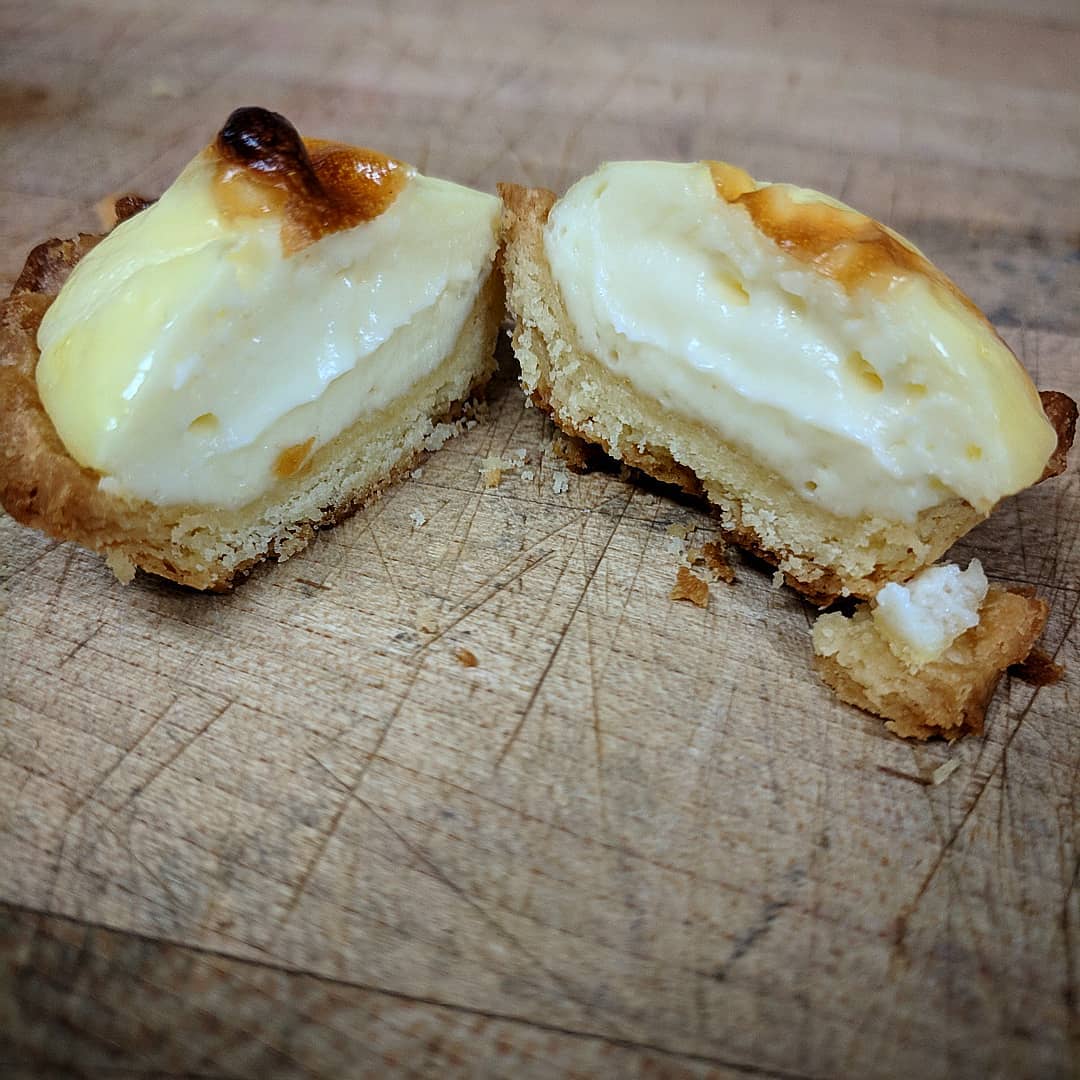
“Japanese cheese tart thanks to @dreamersloft17 for this awesome recipe!”
Three photos of these: a finished tart broken open to show the soft, creamy center under a blistered top, then two trays of small shells mid-production, each holding a piped mound of pale cheese filling. I have @dreamersloft17 to thank for the recipe.
The baked cheese tart in this style comes from Hokkaido, Japan's dairy region, and it became a street-food sensation across Asia in the 2010s. It's a twice-baked, shortbread-like shell filled with a blend of cream cheeses cooked into a custard. You pipe the filling in a dome, then bake it hot and fast so the top colors while the inside stays molten. Served warm it flows, and chilled it eats like cheesecake.
This article is written in Corey’s voice for this tribute site, based on his captions and blog. His own words are the quotes above.
Hokkaido Baked Cheese Tarts
These small tarts pair a crisp butter cookie shell with a mousse-like cheese filling that is baked briefly at high heat so the top browns while the centre stays soft and creamy. The style comes from Hokkaido, Japan's dairy region, and was popularised in the 2010s by the Sapporo confectioner Kinotoya and its BAKE Cheese Tart shops.
Ingredients
Sablé shells
- 200 g all-purpose flour (1 2/3 cups)
- 25 g almond flour (1/4 cup)
- 70 g powdered sugar (1/2 cup plus 1 tbsp)
- 2 g fine salt (1/3 tsp)
- 120 g unsalted butter, soft but cool (8 1/2 tbsp)
- 40 g egg, beaten (about 3/4 of a large egg)
Cheese filling
- 250 g full-fat cream cheese (9 oz)
- 60 g mascarpone (1/4 cup)
- 30 g finely grated Parmesan (1/3 cup)
- 40 g unsalted butter (3 tbsp)
- 120 g whole milk (1/2 cup)
- 45 g powdered sugar (6 tbsp)
- 12 g cornstarch (1 1/2 tbsp)
- 50 g egg (1 large)
- 10 g lemon juice (2 tsp)
- 3 g vanilla extract (1/2 tsp)
Glaze
- 20 g egg yolk (1 large)
- 5 g milk or water (1 tsp)
Method
- Make the sablé: beat the butter, powdered sugar and salt until smooth, add the almond flour and egg, then the flour, mixing just until combined. Wrap and chill 1 hour.
- Roll to 3 mm (1/8 inch), cut rounds and line twelve 7 cm (2.75 inch) tartlet tins. Prick the bases and freeze 20 minutes.
- Bake at 350°F (175°C) for 15-18 minutes until golden all over, pressing the bases down with a spoon if they puff. Cool completely in the tins.
- For the filling, melt the cream cheese, mascarpone, Parmesan, butter and milk in a bowl over simmering water, stirring until smooth.
- Whisk in the powdered sugar and cornstarch, then the egg. Keep stirring over the water until the mixture thickens to a soft custard that holds a trail, about 150-160°F (65-71°C).
- Off the heat, stir in the lemon juice and vanilla, then press through a fine sieve. Cover the surface with plastic wrap and chill at least 2 hours until thick enough to pipe.
- Heat the oven to 450°F (230°C). Pipe the filling into the shells in a tall mound that rises above the rim, then freeze the filled tarts for 20 minutes.
- Brush the domes gently with the yolk beaten with milk. Bake on an upper rack for 6-8 minutes, until the tops are glossy and golden brown.
- Serve warm for a flowing centre, at room temperature for a soft mousse, or chilled for a texture like light cheesecake.
Chef’s notes
- The short, very hot bake is the whole technique. A cooler oven sets the filling all the way through before the top can colour.
- Do not skip the freeze before baking. A cold dome holds its shape and stays creamy in the middle.
- Lumpy filling means the cheese was not fully melted before the egg went in. Sieving fixes it.
- Parmesan adds the savoury depth these tarts are known for. Use it finely grated so it melts completely.
Drawn from the methods of
- BAKE Cheese Tart, Japan
- Kinotoya, Sapporo
- Ferrandi Paris, French Pâtisserie (2017)
Corey has not published his own formula for this piece. This reference recipe is compiled from the published methods of the chefs and bakers listed above, written in our own words.