"Croissants, Need I Say More?"
July 6, 2017
“Croissants, need I say more?”
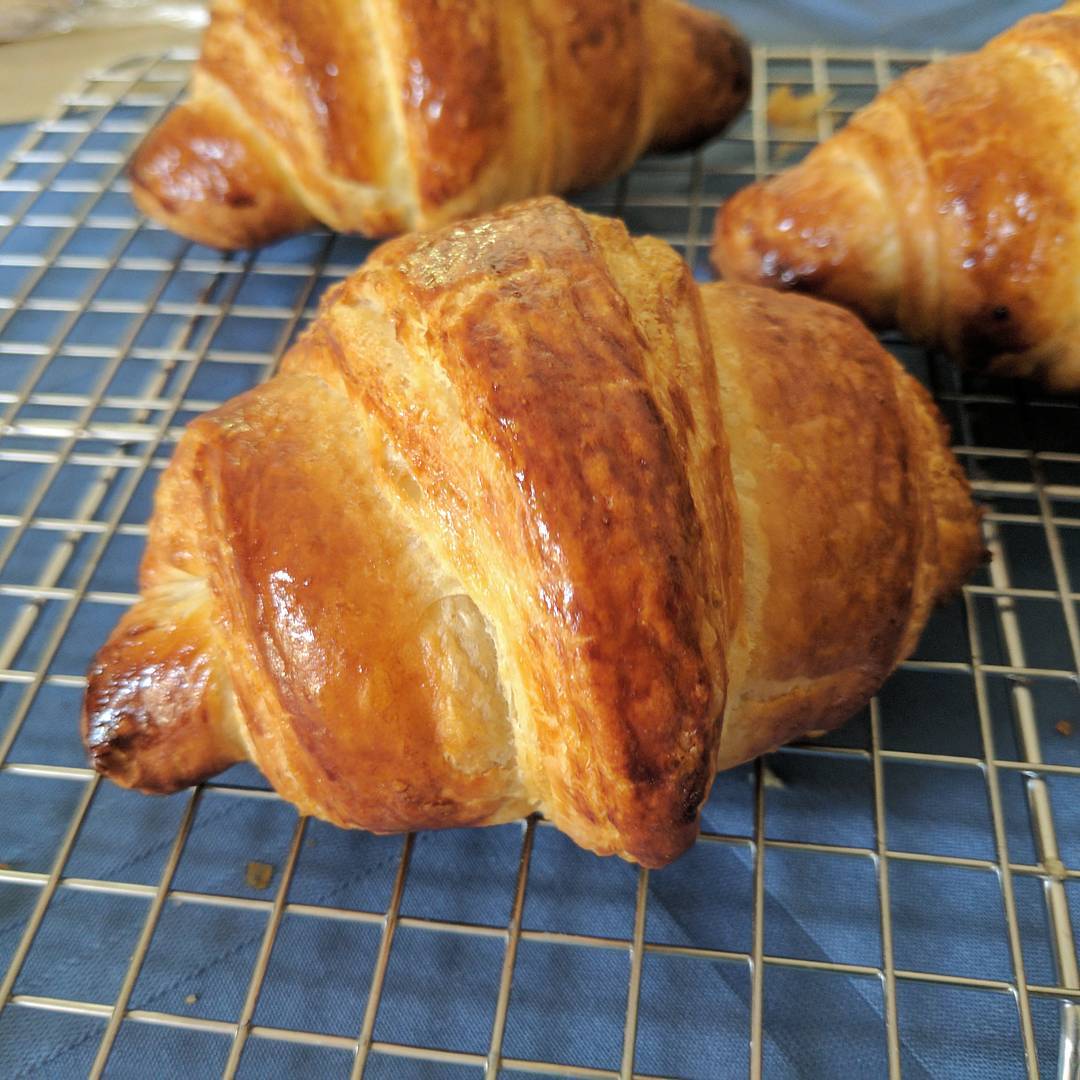
July 2017. Croissants, need I say more? One sits on a cooling rack, deeply bronzed and glossy with egg wash, the layers on its shoulders flaking apart, with more behind it.
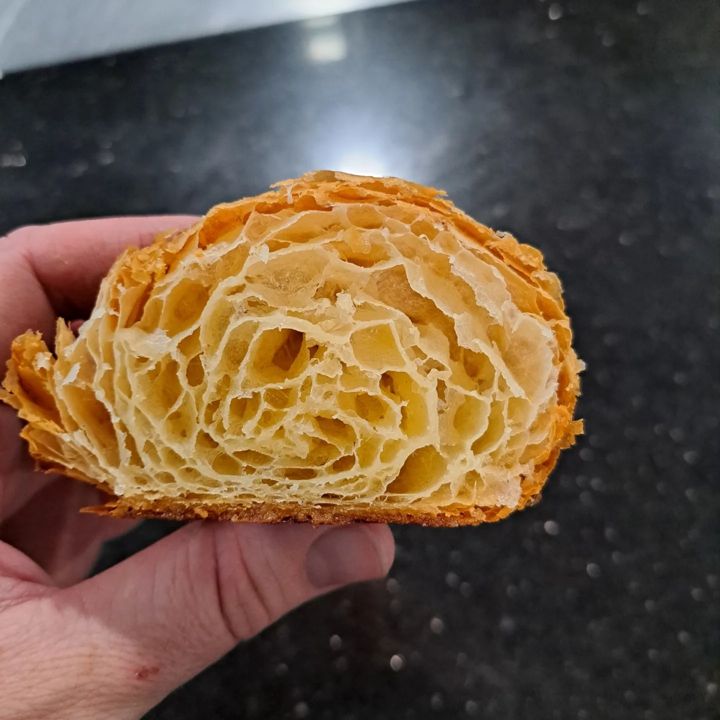
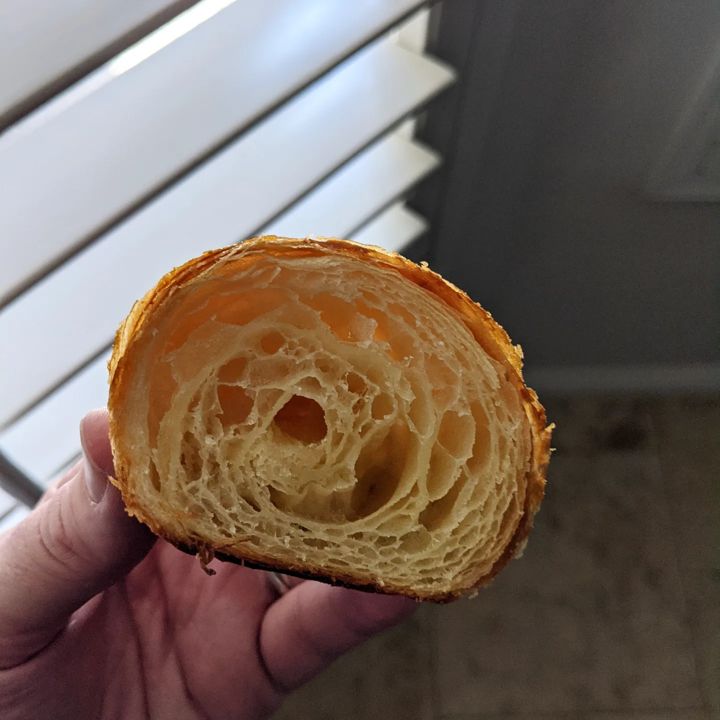
This is four months after the blog post where I called my first croissants merely alright and promised a round two. Here it is. The exterior shows clear improvement: the layers have separated and the shape has held. The croissant as we know it took form in Paris in the nineteenth and early twentieth centuries, developed from the Austrian kipferl, which is why this family of pastries is called viennoiserie, things of Vienna.
This article is written in Corey’s voice for this tribute site, based on his captions and blog. His own words are the quotes above.
Classic Butter Croissants
The croissant is a yeasted, laminated dough: a lean, lightly sweet base folded around a sheet of butter until it holds dozens of alternating layers. Its ancestor is the Austrian kipferl, brought to Paris in the late 1830s by August Zang's Boulangerie Viennoise, and French bakers turned it into the flaky laminated pastry we know by the early 20th century.
Ingredients
Dough (détrempe)
- 500 g bread flour, 11.5 to 12.5% protein (about 4 cups)
- 140 g cold water (1/2 cup plus 1 1/2 tbsp)
- 140 g cold whole milk (1/2 cup plus 1 1/2 tbsp)
- 55 g granulated sugar (1/4 cup plus 1 tsp)
- 40 g unsalted butter, soft (3 tbsp)
- 11 g instant yeast (1 tbsp plus 1/2 tsp)
- 12 g fine sea salt (2 tsp)
Butter block
- 280 g European-style unsalted butter, at least 82% fat, cold (2 1/2 sticks)
Egg wash
- 1 large egg
- 1 large egg yolk
- 15 g milk or cream (1 tbsp)
- Pinch of salt
Method
- Mix all the dough ingredients on low speed for 3 minutes, then on medium for 3 to 4 minutes, until smooth but not fully developed. Rest covered at room temperature for 45 minutes, press into a 20 cm (8 in) square, wrap, and refrigerate overnight (8 to 16 hours).
- Pound the cold butter between two sheets of parchment into an even 18 cm (7 in) square. Chill it until firm but bendable, about 55-60°F (13-15°C). It should flex without cracking.
- Roll the dough to a 26 cm (10 in) square, set the butter on it turned 45 degrees like a diamond, and fold the four corners over to seal it in completely. Pinch the seams shut.
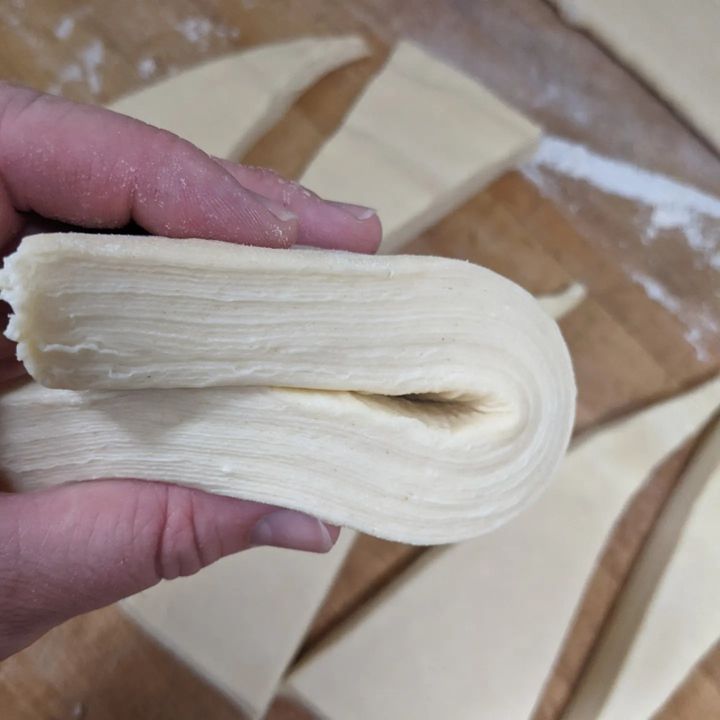
- Roll the package to a 20 x 60 cm (8 x 24 in) rectangle and fold it in thirds like a letter. That is one single fold. Wrap and chill for 30 minutes, then repeat twice more for three single folds in total, turning the dough 90 degrees each time and chilling between folds.
- After the last fold, chill for at least 1 hour. Roll the dough to a 24 x 66 cm (9 1/2 x 26 in) rectangle about 4 mm thick, trim the edges, and cut 12 tall triangles with 10 cm (4 in) bases.
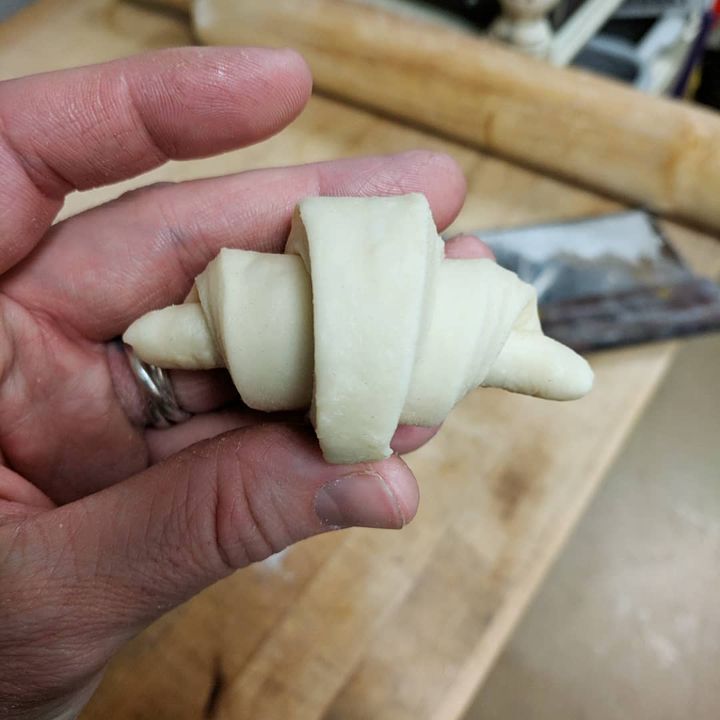
- Cut a small notch in the centre of each base, stretch the triangle gently to lengthen it, and roll from base to tip without pressing down. Set on parchment-lined trays with the tip tucked underneath, 6 per tray.
- Brush lightly with egg wash and proof at 75-79°F (24-26°C) for 2 to 2 1/2 hours. They are ready when they have nearly doubled, the layers are visible at the cut edges, and the tray wobbles like jelly when shaken. Do not proof warmer than 82°F (28°C) or the butter will melt out.
- Heat the oven to 400°F (200°C). Egg wash a second time, avoiding the cut layers, and bake for 10 minutes. Reduce to 375°F (190°C) and bake 10 to 14 minutes more, until deep mahogany brown.
- Cool on a rack for at least 20 minutes before eating so the crumb can set.
Chef’s notes
- Butter leaking in the oven almost always means underproofing or a proof that was too warm. Give the croissants the full time at a moderate temperature and look for the wobble.
- If the butter shatters into pieces while rolling, it is too cold. Let the dough sit for 5 minutes and try again. If it smears or feels greasy, it is too warm: chill 20 minutes.
- Dense, bready interiors come from pressing too hard with the pin or from too many folds. Three single folds give 27 butter layers, which is the classic count for an open honeycomb.
- Shaped croissants freeze well before proofing. Thaw overnight in the refrigerator, then proof and bake as directed.
Straight dough or preferment?
Straight dough with an overnight cold rest
Ferrandi Paris, Le Cordon Bleu, Claire Saffitz
All the ingredients are mixed at once and the dough develops flavour slowly in the refrigerator. It is the standard French school method, gives a clean buttery taste, and is the method this recipe follows.
Poolish or other preferment
Thomas Keller and Sebastien Rouxel (Bouchon Bakery), Chad Robertson (Tartine)
Part of the flour and water is fermented for 12 hours or so before the final mix. Supporters argue it adds a deeper, slightly tangy wheat flavour and makes the dough more extensible and easier to roll.
Drawn from the methods of
- Ferrandi Paris, French Pâtisserie (2017)
- Thomas Keller and Sebastien Rouxel, Bouchon Bakery (2012)
- Claire Saffitz, Dessert Person (2020)
- Jeffrey Hamelman, Bread (2004)
Corey has not published his own formula for this piece. This reference recipe is compiled from the published methods of the chefs and bakers listed above, written in our own words.